
Why Hosting and Domains Confuse Beginners
For many beginners, hosting and domains feel confusing before they even begin. The terms sound technical. The explanations online often feel rushed or filled with jargon. As a result, many people assume these concepts are only for developers or “tech people,” and they delay learning them longer than they should.
In reality, the confusion comes from how these ideas are explained, not from what they actually are. Every website, no matter how simple, is built on just two foundations: a name and a place to live. The name is the domain. The place to live is the hosting. Nothing more. Nothing hidden.
Hosting and domains are not skills you need to master. They are services you choose, similar to renting a shop and putting a sign on the door. Once this is understood, much of the fear disappears. You are not learning to code. You are simply learning how websites are set up to exist online.
This understanding matters because websites sit at the center of most online work and business models today. This also reflects a broader principle that technology is a support system, not a shortcut to results.
What Is a Domain Name? (Your Website’s Address)
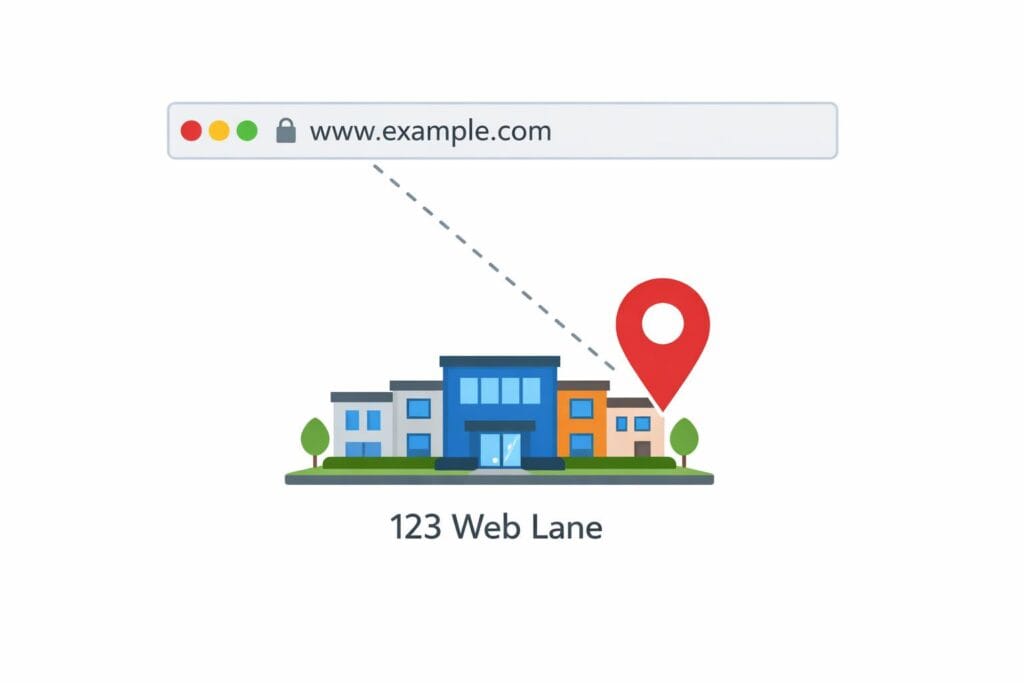
A Domain Explained in Everyday Language
A domain name is simply the address of your website. It is what people type into their browser to find you online. Instead of remembering long strings of numbers, humans use names because they are easier to read, remember, and share.
Behind every website is a numeric address, similar to a phone number. Computers understand numbers very well. People do not. Domain names exist to bridge that gap. They translate complex numerical locations into clear, human-friendly words.
Think of a domain like a street address. The building exists whether or not the sign is clear. But without a readable address, no one knows where to go. In the same way, your website can exist on the internet, but the domain is what makes it reachable and recognizable to people.
For beginners, this is an important shift in thinking. A domain is not a technical tool you “build.” It is a label you choose so others can find your website easily.
How Domain Names Work Behind the Scenes
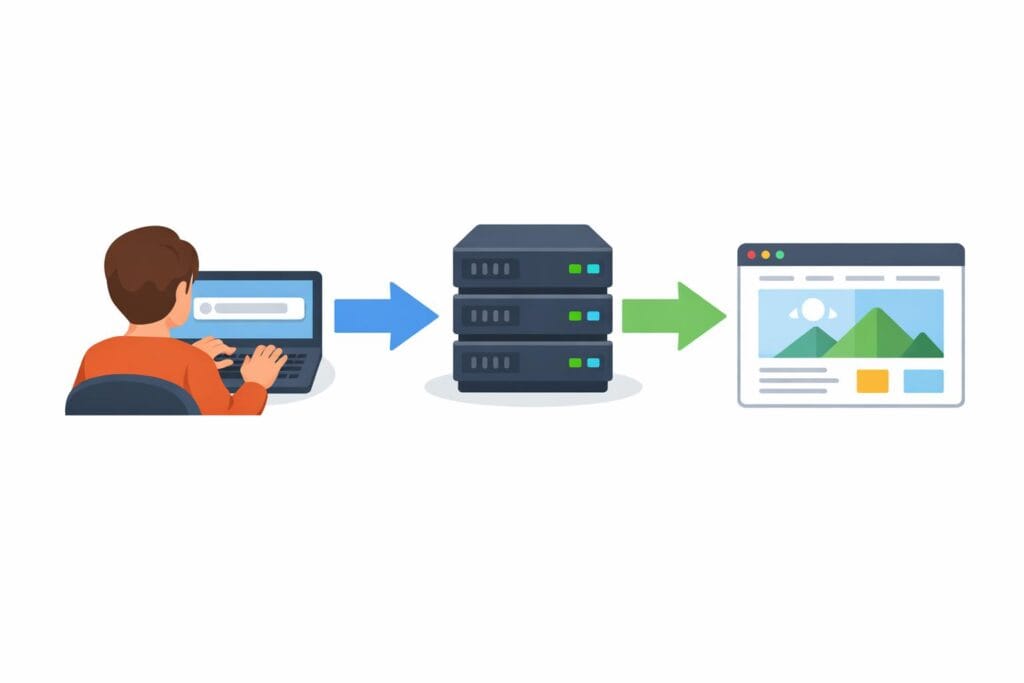
When someone types a domain into a browser, the browser does not magically know where the website lives. It asks a global directory for help. This directory acts like an internet phone book.
The request goes out. The directory replies with the correct numeric location of the website. The browser then connects to that location and loads the site. All of this happens in seconds, without the user ever noticing.
You do not need to manage this process yourself. It runs automatically in the background. Your only role is choosing and registering the domain name. The system handles the rest.
Why Choosing a Domain Matters
A domain is often the first impression people have of a website. A clear, simple name feels trustworthy. A confusing or overly long name can create doubt before the site even loads.
Domains also play a role in branding and memorability. A name that is easy to spell and recall is easier to share. Over time, that familiarity builds recognition.
Most importantly, domain choices are long-term. While designs and tools change, domains often stay for years. Choosing thoughtfully at the beginning helps avoid unnecessary changes later.
What Is Web Hosting? (Where Your Website Lives)
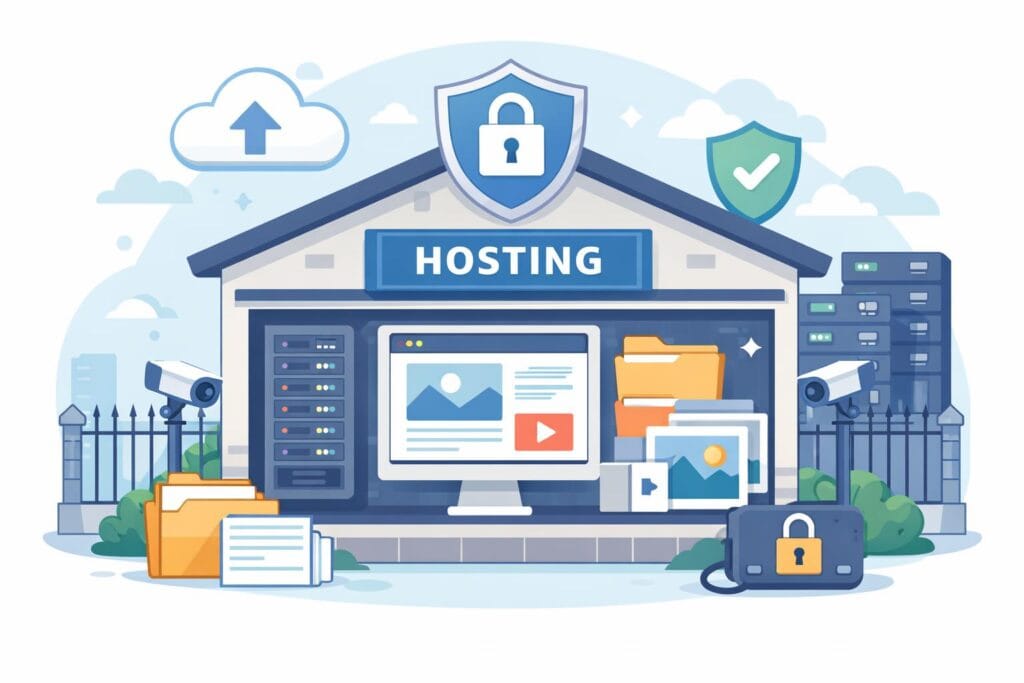
Web hosting is the service that gives your website a place to exist on the internet.
Without hosting, a website cannot be accessed by anyone, no matter how good the design or content is.
Many beginners confuse hosting with domains or think hosting is a technical skill. In reality, hosting is simply a service you use, not something you build or code yourself. Its job is to keep your website available, visible, and accessible at all times.
Think of hosting as the foundation that quietly supports everything else. When hosting works well, you barely notice it. When it doesn’t, visitors quickly feel the impact.
Hosting Explained Simply
Web hosting is like renting space online where your website lives.
Just as a shop needs a physical location, a website needs a digital place.
That rented space stores all the parts of your website:
Text and written content
Images and media files
Pages and layouts
These files are kept on powerful computers that stay connected to the internet day and night. Hosting providers manage these computers for you, so you don’t need technical knowledge to use them.
How Hosting Delivers Websites to Visitors
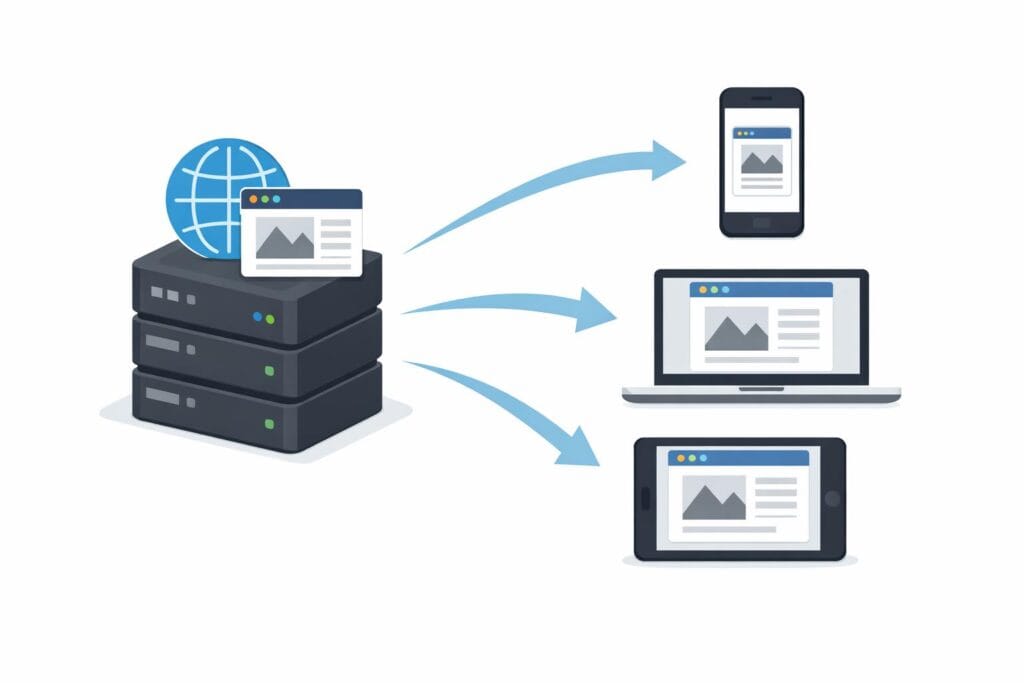
When someone types your website address into a browser, a request is sent across the internet.
Your hosting server receives that request.
The server then sends your website’s files back to the visitor’s browser.
Within seconds, the page appears on their screen.
This process happens every time someone visits your site.
Good hosting handles these requests smoothly, even when multiple people visit at once.
Why Hosting Quality Matters
Not all hosting services are equal. The quality of hosting directly affects how your website feels to visitors.
Speed: Faster hosting means pages load quickly, keeping visitors engaged.
Reliability: Good hosting keeps your site online without frequent downtime.
Security basics: Reliable hosting protects your site from common issues Understanding basic online security habits also strengthens this protection layer.
For beginners, choosing stable and simple hosting matters more than advanced features. A calm, reliable setup allows you to focus on learning and creating content, not fixing problems.
Hosting vs Domain — The Key Difference Beginners Miss
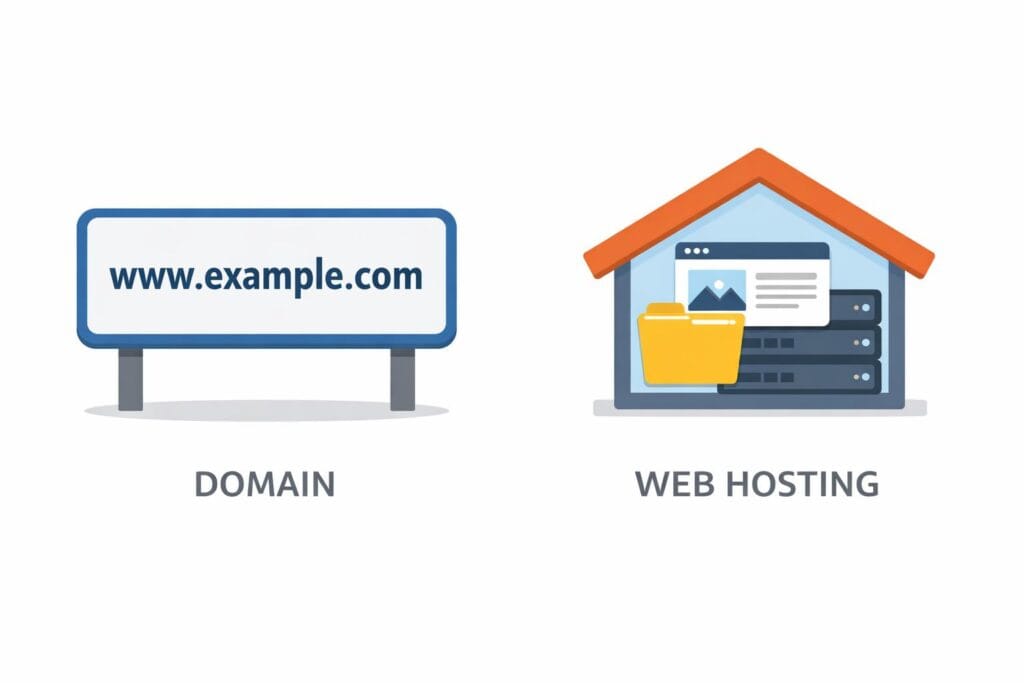
One of the most common points of confusion for beginners is mixing up hosting and domains. They are closely connected, but they are not the same thing. Understanding this difference early removes a lot of unnecessary frustration when starting a website.
Many beginners think buying a domain automatically creates a website. Others assume hosting alone is enough. In reality, each plays a separate role, and both are required for a website to function properly.
Domain Is the Address, Hosting Is the House
A simple way to understand this is through a real-world example.
The domain is your address. It tells people where to find you.
The hosting is the house itself. It holds everything inside.
An address without a house gives people nowhere to visit.
A house without an address cannot be found.
In the same way, a domain points visitors to your website, while hosting stores the website’s content and makes it visible online.
Why You Need Both to Have a Website
If you only buy a domain, visitors will see nothing because there is no website connected to it.
If you only have hosting, your website exists, but no one can reach it without an address.
This is why beginners sometimes feel “stuck” after paying for one service. The website setup feels broken, when in fact one piece is simply missing.
Once both are connected, the website becomes accessible to anyone online.
Can Hosting and Domains Be Bought Separately?
Yes, hosting and domains can be purchased from different providers. Many people do this for flexibility or pricing reasons.
Pros:
Freedom to choose better services
Easier switching later
Cons:
Slightly more setup steps
Requires careful connection between services
For beginners, buying both from the same provider is often simpler. As experience grows, separating them can make more sense.
How Hosting and Domains Work Together (Step-by-Step)
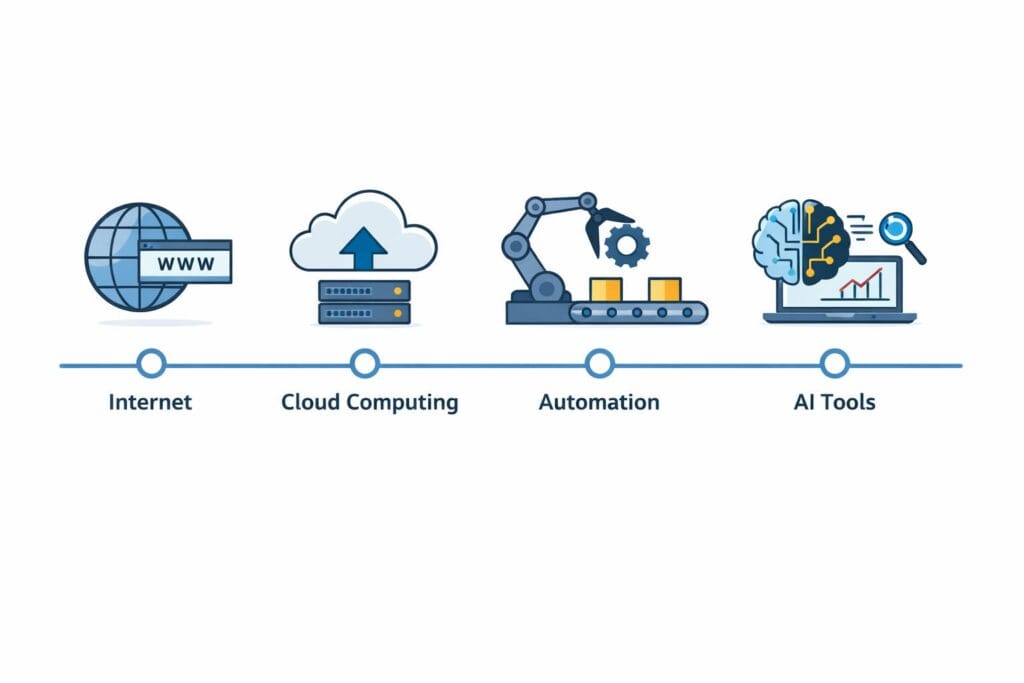
Once beginners understand what a domain and hosting are, the next question is simple: how do they actually work together?
The good news is that the process is logical and far less technical than it sounds. You do not need to understand servers or coding to grasp the big picture.
At a high level, domains and hosting act as a connected system. One tells visitors where to go, and the other decides what they see when they arrive.
From Typing a Domain to Seeing a Website
When someone types a website address into a browser, a short chain of events happens almost instantly.
The browser reads the domain name.
The domain system checks where that domain points.
The request is sent to the hosting server.
The website files stored on hosting are delivered back to the browser.
From the visitor’s point of view, this feels like one simple action. Behind the scenes, it is a handoff between the domain and the hosting, working together as a team.
Connecting a Domain to Hosting
Connecting a domain to hosting simply means telling the domain where the website lives.
Without this connection, the domain has no destination. It is like writing an address without listing the building.
Once connected, the domain knows which hosting service to send visitors to.
This step matters because it turns two separate services into a functioning website. Until they are linked, nothing appears online, even if both have been paid for.
What Beginners Should Know (and Ignore)
What matters early:
The domain must point to the correct hosting
The hosting must contain actual website content
The connection only needs to work reliably
What can wait until later:
Advanced hosting settings
Performance tuning
Technical optimization terms
For beginners, understanding the relationship is more important than mastering the details. Once this foundation is clear, everything else in website building becomes much easier to learn.
Common Types of Hosting (Explained Without Jargon)
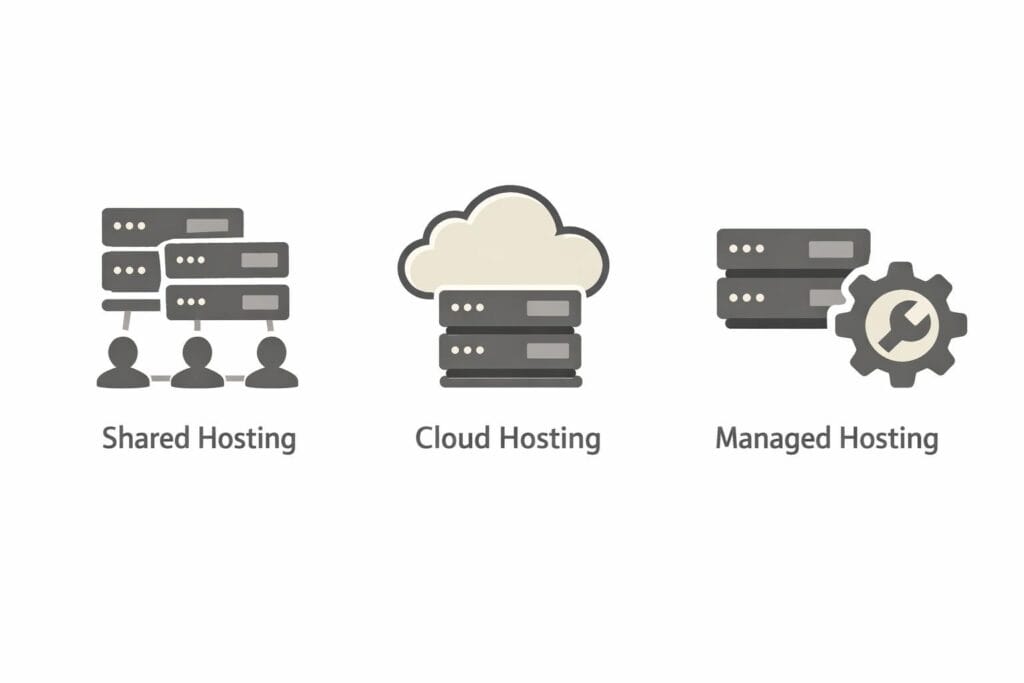
Not all hosting works the same way. Beginners often feel overwhelmed because hosting plans come with many unfamiliar names. In reality, most websites only need to understand a few basic types. Each one exists for a clear reason, and none of them are “better” by default. They are simply designed for different stages of growth.
The key is choosing what fits your current needs, not what sounds advanced.
Shared Hosting
Shared hosting is the most common starting point for beginners.
It means your website lives on a server that also hosts many other websites. All of them share the same resources, such as space and power. This sounds negative at first, but for small or new websites, it works very well.
Beginners often start here because it is affordable, simple, and requires almost no technical knowledge. The hosting provider handles most background tasks, while you focus on building content and learning how websites work. For blogs, learning projects, and early online businesses, shared hosting is usually more than enough.
VPS and Cloud Hosting (High-Level Only)
VPS and cloud hosting exist for websites that outgrow shared hosting.
Instead of sharing everything, these options give a website more dedicated space and flexibility. This helps when traffic increases or when a site needs more stability under heavier use.
For beginners, these types are rarely needed at the start. They become relevant later, when a website grows consistently and performance limits are clearly felt. Until then, thinking about VPS or cloud hosting usually adds unnecessary complexity.
Managed Hosting
Managed hosting focuses on convenience rather than control.
With managed hosting, the provider takes care of updates, security basics, backups, and performance tasks. You still own the website, but you are not responsible for technical maintenance.
Beginners like managed hosting because it reduces stress. It allows learning and content creation to stay front and center, without worrying about technical details. This makes managed hosting a popular choice for those who want simplicity and reliability from day one.
Understanding these hosting types helps beginners choose calmly, without chasing features they do not yet need.
Choosing Hosting and Domains as a Beginner
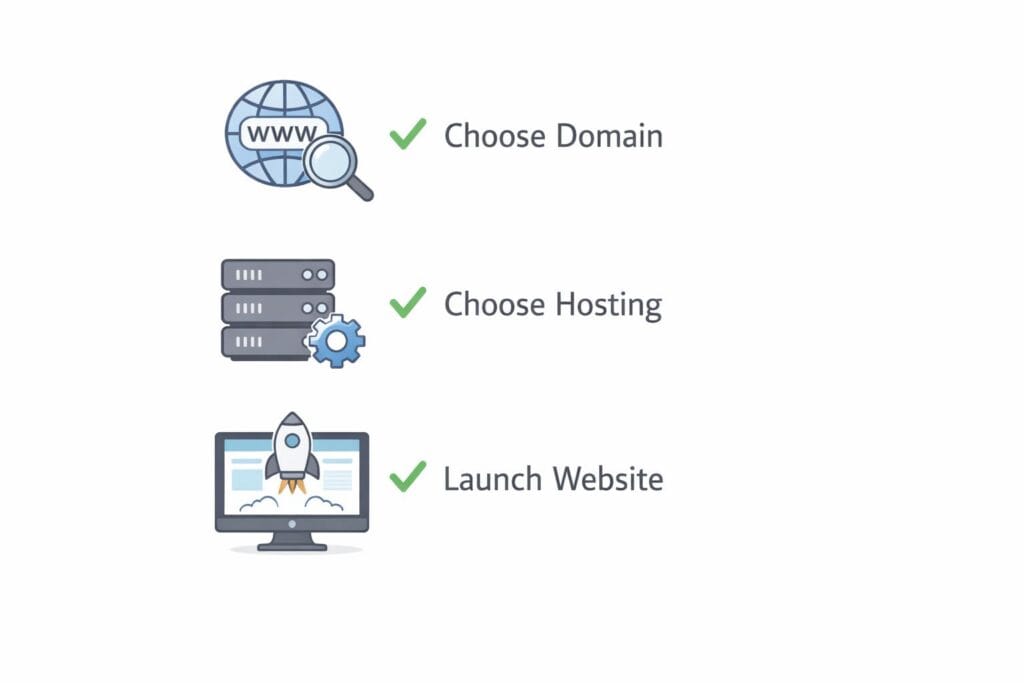
For beginners, choosing hosting and a domain often feels harder than it really is. Most confusion comes from focusing on features instead of fundamentals. Hosting companies list many options, but early success online rarely depends on advanced settings. It depends on stability, clarity, and making progress without stress.
At the beginner stage, the goal is not to build the perfect setup. The goal is to build a setup that works consistently while you learn.
What Matters More Than Features
Reliability matters more than complexity.
A hosting service that stays online, loads pages consistently, and does not break often is far more valuable than one packed with advanced tools you do not use. Beginners benefit most from predictable performance, not customization.
Support also matters more than advanced options.
When something feels confusing, being able to reach clear, human support saves time and frustration. Good support shortens the learning curve and prevents small issues from stopping progress.
Free vs Paid Domains and Hosting
Free options can be useful in limited situations.
They are okay for temporary learning, experiments, or personal practice projects. However, free services often come with restrictions, branding, or limited control.
Paid domains and hosting make sense when you want ownership and stability.
Paying usually means better reliability, full control over your website, and fewer limitations. For anyone serious about online work or long-term projects, paid options quickly become the practical choice.
Beginner Decision Framework
A simple framework works best at the start.
Choose one clear domain name that is easy to remember.
Choose one reliable hosting provider that fits your current needs.
Avoid overthinking upgrades, features, or future scaling too early.
This calm approach helps beginners move forward, learn faster, and build confidence without unnecessary pressure.
How Hosting and Domains Support Online Business and Work
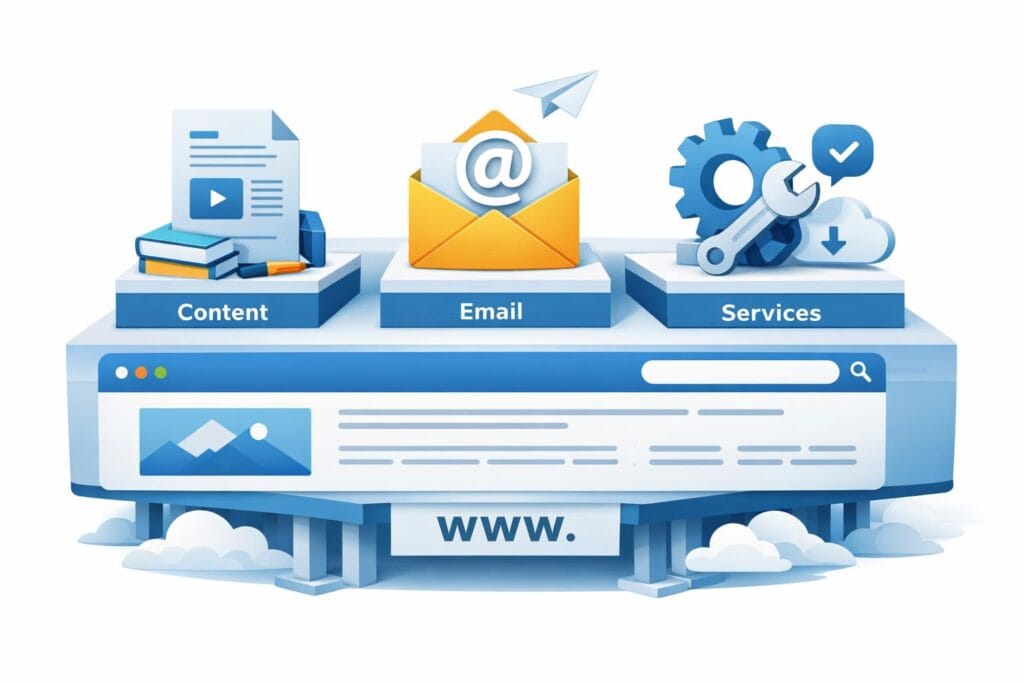
Hosting and domains do more than make a website visible. Together, they form the base layer that supports almost all serious online work. When beginners understand this role early, decisions become calmer and more strategic.
A website is not just pages on a screen. It is an owned space where work, communication, and trust can grow over time.
explored further in our complete beginner framework on how technology supports sustainable online business models
Websites as Digital Foundations
Websites act as stable digital foundations for many activities.
They hold content that explains ideas, teaches skills, or answers questions. Unlike social posts, this content remains accessible long term and can be improved gradually.
Websites also support email communication. Email sign-ups, contact forms, and updates usually rely on a website as the central point of connection.
Services and trust grow from this structure. This is especially true for beginners building structured skill-based online work.
Hosting, Domains, and Long-Term Control
Hosting and domains give ownership instead of dependence.
Platforms can change rules, limit reach, or disappear. A domain and hosting keep control in the hands of the website owner. Content, structure, and direction are not tied to trends or algorithm changes.
Stability matters more than popularity. Long-term online work benefits from steady growth rather than chasing fast visibility on changing platforms.
This control allows skills, content, and systems to mature at a sustainable pace.
This relationship between hosting, domains, and ownership connects directly to the broader idea of how technology supports consistent online work.
For a deeper understanding of how these foundations fit into sustainable digital models, this is explored further in Technology and Online Business – The Complete Beginner’s Guide.
Common Myths About Hosting and Domains
Many beginners struggle with hosting and domains not because they are difficult, but because of common myths that make them feel intimidating. Clearing these misunderstandings early helps people make calmer, smarter decisions and move forward without unnecessary fear.
“Hosting Is Too Technical”
This belief usually comes from how hosting is explained online. Tutorials often focus on settings, dashboards, and terms that beginners do not need at the start.
The reality is simpler. Hosting is a service, not a skill. Beginners do not need to understand servers or technical systems to use hosting effectively. Most modern hosting platforms are designed for non-technical users and handle complex tasks in the background.
At the beginner level, hosting is about choosing a reliable provider and letting the system do its job.
“Domains Are One-Time Decisions”
Many people believe a domain choice is permanent and fear making a mistake.
In practice, domains can change. Websites can be renamed, redirected, or rebranded as goals become clearer. While changing a domain later requires planning, it is not a failure or a disaster.
A good rule is simple. Keep a domain if it still represents the purpose of the website. Consider change only when the direction has clearly shifted.
“Expensive Hosting Equals Success”
Price alone does not create results.
Expensive hosting does not guarantee traffic, trust, or growth. What actually drives results is clear content, consistency, and patience over time. Reliable hosting matters, but beyond basic quality and support, higher cost rarely replaces effort and strategy.
Success comes from how the website is used, not how much the hosting plan costs.
Frequently Asked Questions (FAQ)
This section addresses the most common questions beginners ask when trying to understand hosting and domains. Clear answers here remove doubt and help people move forward with confidence.
Do beginners really need hosting and a domain?
Yes, if the goal is to have a real website that you own and control.
A domain gives your website a clear identity, while hosting provides the space where the site exists. Free platforms can work for learning or testing ideas, but they do not offer the same control, stability, or long-term value. For anyone serious about online work, hosting and a domain form the basic foundation.
Can I use hosting without a domain?
Technically, yes, but it is not practical for beginners.
Hosting accounts can exist without a custom domain, often using temporary addresses. However, these are hard to remember and not suitable for public use. A domain makes a website accessible, trustworthy, and easy to share. In real-world use, hosting and a domain work best together.
How much should beginners spend?
Beginners do not need expensive plans.
A simple domain and basic hosting are enough to start. The focus should be reliability and support, not advanced features. Spending more does not speed up success. Consistency and learning matter far more than price at this stage.
Can hosting be changed later?
Yes. Hosting is not permanent.
Websites can be moved to a different hosting provider if needs change. Many people start small and upgrade later as traffic or requirements grow. This flexibility allows beginners to start without fear of making the “wrong” choice.
Are domains permanent?
No. Domains can be changed, renewed, or replaced.
While it is best to choose carefully, domains are not lifelong decisions. Rebranding or changing direction is common. What matters is choosing something clear and appropriate for the current goal, not perfection from day one.
Conclusion: Hosting and Domains Are Simpler Than They Seem
Hosting and domains often feel intimidating at first. Not because they are complex, but because they are usually explained in complicated ways. In reality, they are services designed to support websites, not barriers meant to block beginners. A domain gives your website a clear identity. Hosting provides the space where that website lives. That is their core purpose.
Once these ideas are understood, much of the fear disappears. You no longer feel like you are dealing with hidden technical systems. Instead, you see two practical tools that make websites possible. This understanding is far more valuable than memorizing terms or chasing advanced features.
For beginners, simple choices work best. One clear domain. One reliable hosting provider. That is enough to begin learning, publishing, and growing. There is no need to overthink decisions at the start. Most websites evolve over time, and these foundations can evolve with them.
When hosting and domains stop feeling mysterious, building online becomes calmer and more focused. Confidence comes from understanding, not complexity. And once these basics are clear, everything that follows — content, skills, and online growth — becomes much easier to manage.



One Comment on “Understanding Hosting and Domains in Simple Terms (Beginner Guide)”