
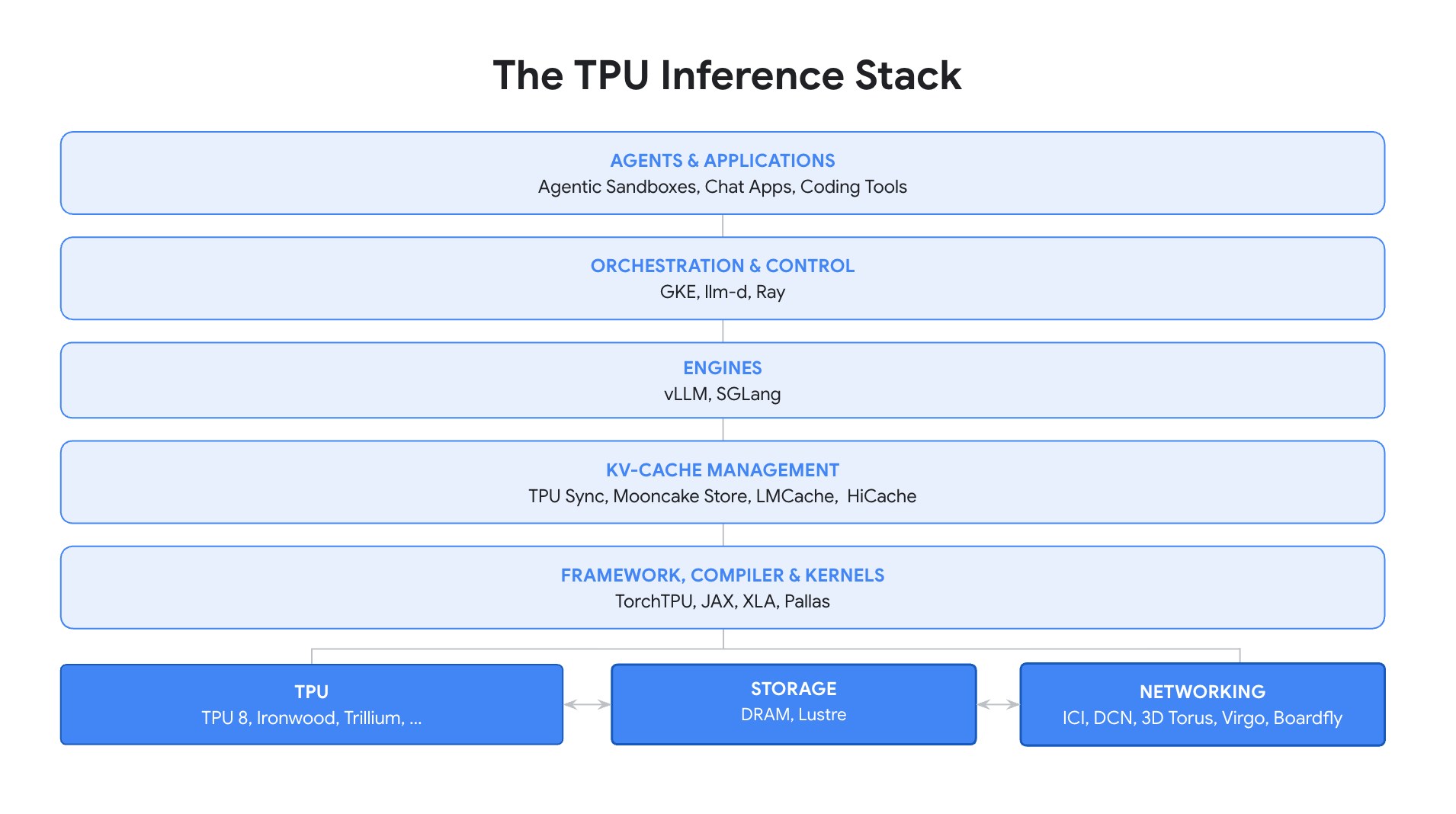
Google announced native PyTorch backends for vLLM and SGLang on October 20, built on TorchTPU with Inferact and RadixArk. The engines previously had TPU paths based on JAX. The new approach is intended to let developers customize and debug serving through familiar PyTorch tools while retaining much of each engine’s existing architecture.
Google describes support for capabilities including prefix caching, structured outputs, tool calling, speculative decoding, and several forms of parallel execution. These features matter because a hardware migration is not useful if it removes behavior the application depends on. The integration targets the serving system around the model as well as the accelerator underneath it.
Portability reduces one kind of work
A team already operating a PyTorch-based service may be able to carry over more knowledge, model code, and debugging practices. That can make a new hardware option easier to investigate. It does not establish that every custom operation, checkpoint, or configuration will run unchanged.
Begin with an inventory of the service’s actual dependencies. List the model architecture, numerical formats, output constraints, and custom kernels. Identify which are supported directly and which need an alternative implementation. This makes the migration estimate concrete before a team commits to moving a production workload.
Compare the same service promise
A fair infrastructure comparison holds the required user experience constant. If one system is measured at a generous response-time target and another at a strict target, their cost figures answer different questions. Use the same input distribution, context lengths, concurrency, and acceptable delay.
Include workload transitions. A service can look efficient under steady traffic and behave differently during a burst or after a restart. Measure how quickly capacity becomes useful, how queues build, and whether long requests interfere with short ones. These effects can matter as much as peak generation speed.
Operational familiarity has value
The ability to use familiar tools can reduce the time needed to investigate a failure. Evaluate that benefit directly: can the team locate a problematic operation, reproduce a numerical difference, and inspect the serving state using its normal workflow? A cheaper accelerator can become an expensive choice if every incident requires a separate specialist process.
Keep a small, repeatable acceptance workload for future runtime upgrades. Record both output behavior and performance so a change in the stack does not silently alter the service.
The TorchTPU release broadens the practical hardware choices available to PyTorch teams. Its strongest case is a workload that retains the features users need and becomes easier or cheaper to operate as a complete service, rather than a benchmark that measures only the accelerator’s best moment.
Have a correction or a useful perspective?
Get in touch with the publication.