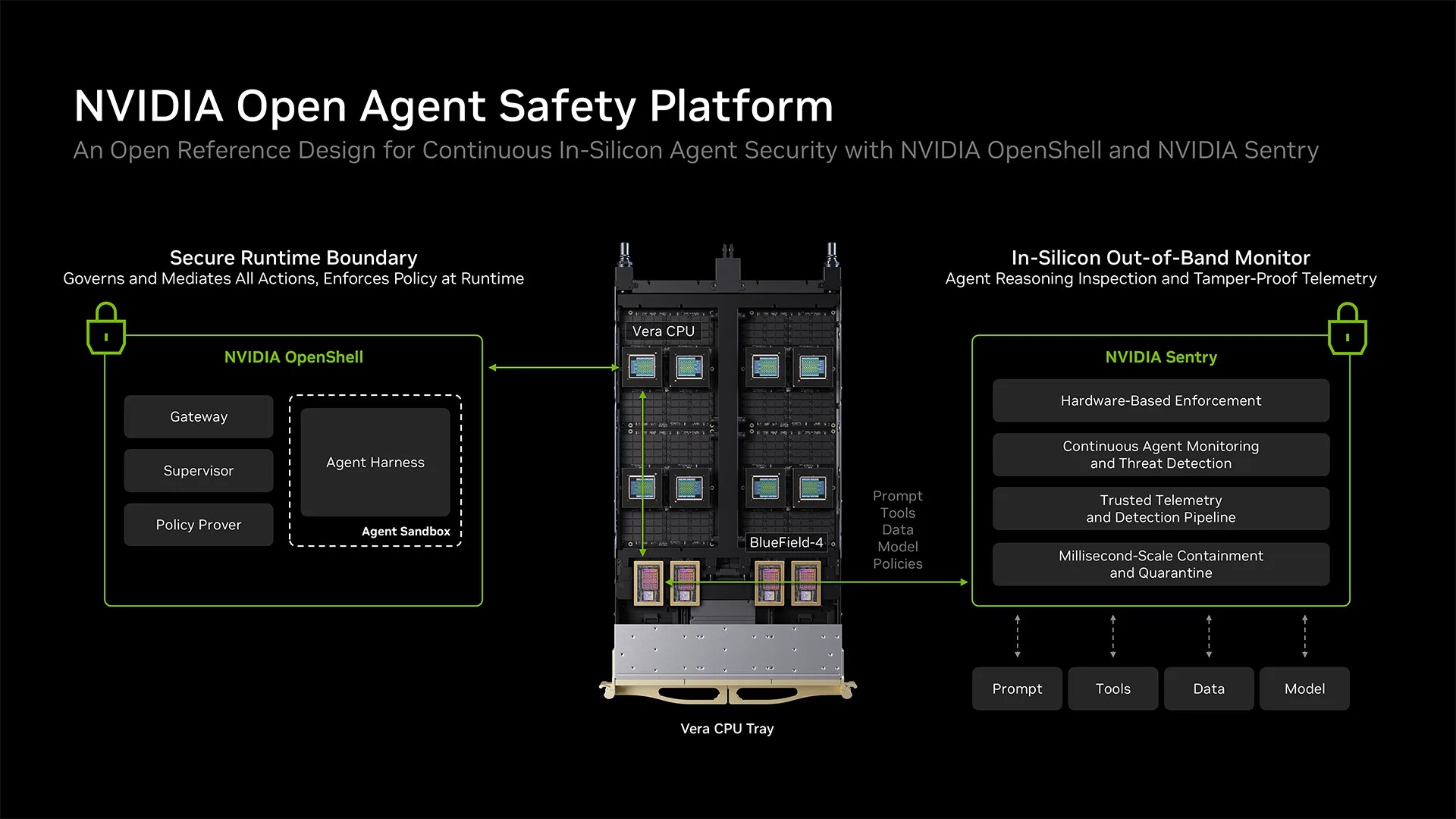
NVIDIA introduced its Open Agent Safety Platform on September 28, describing a stack that combines the OpenShell runtime, Sentry hardware monitoring, and DOCA integration. The company’s proposal places isolation and enforcement outside the agent’s own application logic, including an optional independent layer on BlueField infrastructure.
The architectural issue is straightforward: a control is less trustworthy when the workload it constrains can rewrite or disable it. Moving enforcement to a separate boundary can reduce that conflict. The announcement describes a reference architecture, not proof that every deployment using its components is secure.
Map the paths that remain
A team evaluating independent enforcement should list every way the agent can reach a model, tool, credential, file, or network destination. A protected route is useful only if the workload cannot quietly choose another route with broader permissions. This is a property of the deployment topology as well as the software.
Policies should be specific enough to test. Permission to read a project directory is different from permission to read every mounted volume. Permission to call one internal service is different from unrestricted outbound access. Small, explicit scopes make expected behavior easier to verify.
Test a denied action and inspect the resulting record. The operator should be able to tell which identity requested it, which policy blocked it, and whether any partial effect occurred. A silent failure can send the agent into repeated retries; a clear boundary can allow a controlled handoff.
Plan for degraded operation
Independent controls create their own operational questions. What happens if the policy service is unavailable? Can an operator stop the workload? How are credentials revoked, and where do the audit records remain if the host fails? These decisions belong in the deployment plan before broad access is granted.
Keep the recovery path outside the agent’s permissions. An administrator may need to restore service or inspect a blocked job, but that capability should not automatically become available to the workload. Separate ownership makes it easier to understand who can change the boundary.
The hardware layer also changes procurement considerations. Teams should identify which protections depend on particular infrastructure and which are supplied by the software runtime alone. That distinction helps compare a workstation pilot with a larger deployment.
NVIDIA’s announcement makes independent enforcement a concrete implementation topic. The useful evaluation is whether the complete system maintains its intended boundaries during normal work, failures, and operator intervention, with evidence that can be inspected after the fact.
Have a correction or a useful perspective?
Get in touch with the publication.