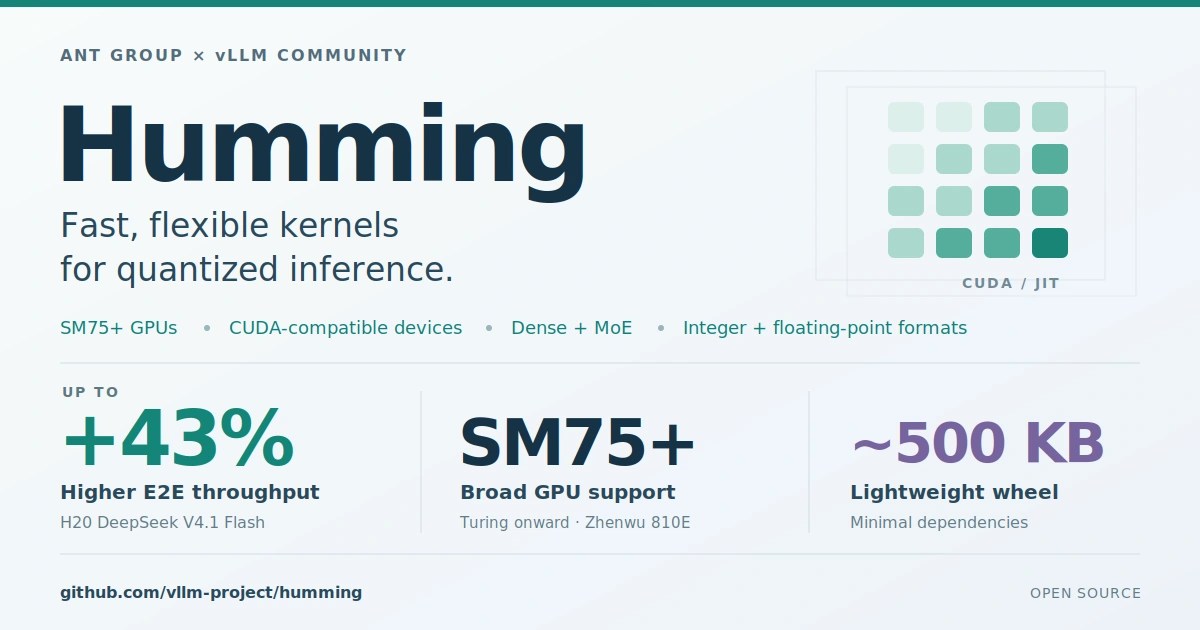
Ant Group and the vLLM community introduced Humming, an open-source approach to quantized inference kernels. Its central idea is to describe a model's quantization separately from the hardware-specific execution strategy, reducing the need for an entirely new implementation for each combination.
The announcement describes support for dense and mixture-of-experts models, NVIDIA GPUs from the Turing generation onward, and CUDA-compatible hardware. Humming generates and caches specialized kernels, drawing on shared components for numerical processing, memory movement, and work scheduling. The project reports performance gains in its own tests, but a deployment decision still needs measurements on the intended workload.
A compatibility problem with an operating cost
Quantization reduces the precision used to store or compute model values. The attraction is straightforward: a smaller representation can reduce memory pressure and sometimes improve serving efficiency. The complication is that several formats can encode information differently, making support expensive to build and difficult to keep consistent.
Separating representation from execution could make that maintenance burden easier to manage. A serving team would have a more systematic way to add a format or adapt to a device. It would still need to check that the resulting answers remain suitable for its application.
An evaluation should include both short, interactive requests and long prompts. The phase that reads the prompt and the phase that generates an answer stress a system differently. A strong average throughput number can conceal slow first responses or poor behavior when several requests arrive together.
Measure the complete deployment
Kernel compilation and caching introduce another operational question. A warm benchmark may not reflect a freshly started worker. Teams should record startup time, cache behavior after a rollout, and performance during a traffic surge, especially if their service scales workers frequently.
Numerical checks also deserve a separate line in the acceptance criteria. Compare representative model outputs before and after the change, including cases where a small error can alter a tool argument or a structured result. Faster generation is useful only if it does not create additional downstream repair work.
For platform operators, Humming is most interesting as infrastructure that may make experimentation less costly. The right first step is a controlled comparison on one model and one real traffic profile, followed by a broader rollout only when the measurements support it. Format coverage and production efficiency should be evaluated as related, but distinct, achievements.
Have a correction or a useful perspective?
Get in touch with the publication.

