Hugging Face announced on September 22 that Transformers could run GGUF quantized models directly. Developers could supply a GGUF filename through the familiar model-loading interface while the implementation reused low-level ggml kernels. The initial performance focus was Apple Silicon and the Qwen3.5 architecture, with compatible software versions required.
This is a useful bridge between two workflows. Python developers often build around Transformers, while local model users choose GGUF files to fit models into available memory. Bringing those paths together can reduce the amount of application code that must change when moving an experiment from a hosted service to a laptop.
The file size is only the starting point
A quantized weight file is smaller than its higher-precision counterpart, but it is not the total memory requirement. Runtime state, the context being processed, and other applications also need memory. A model that loads successfully may still become impractical when a real session contains long documents.
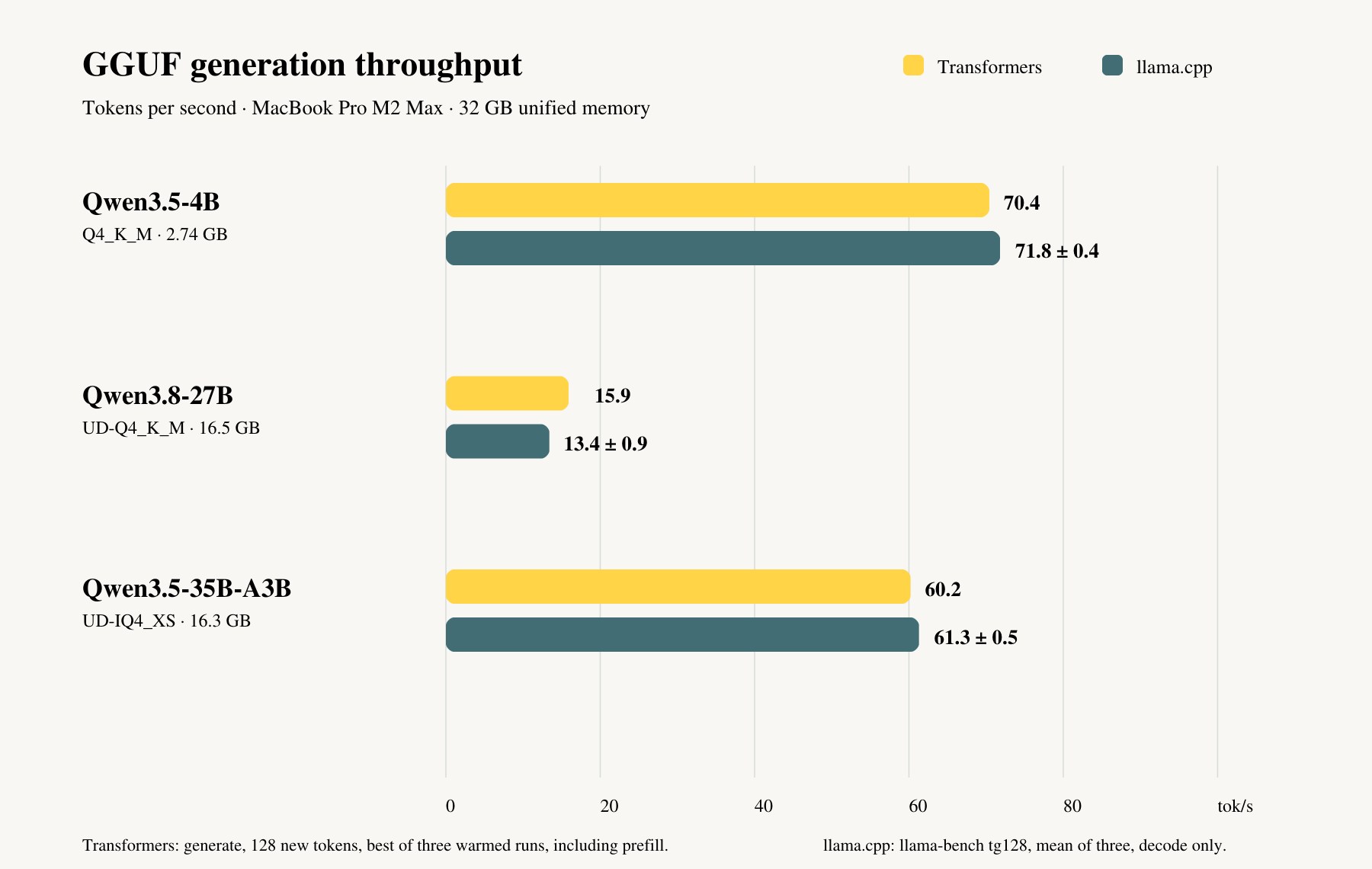
Begin with a representative prompt length and output length. Measure peak memory, first-response delay, and sustained generation speed. Then repeat with the longest input the application intends to accept. This reveals whether a configuration works only in a short demonstration.
Quantization also deserves a task-level quality check. Compare outputs on examples where a small factual or formatting error matters: a structured extraction, a code edit with tests, or a calculation whose answer is independently known. A smaller file does not by itself establish that the quality tradeoff is acceptable.
Preserve the software environment
The announcement’s narrow initial hardware and architecture scope is a reason to record the full environment. Save the model revision, quantization variant, Transformers version, kernel package, operating system, and accelerator backend. Those details determine whether a colleague can reproduce the same result.
Inspect warnings about fallback execution. An application may remain functionally correct while silently taking a slower path, which can explain a performance gap without implying that the model itself changed. Keep cold loading time separate from generation time so caching does not distort comparisons.
The practical benefit is greater flexibility for existing Python projects. A team can prototype local inference without rebuilding every surrounding component, then decide whether its workload fits the initial support matrix. The release is best understood as an additional execution option, with memory, compatibility, and quality still needing to be measured on the actual machine.
Have a correction or a useful perspective?
Get in touch with the publication.

