H Company released the Holo4 family on September 28, including a 27-billion-parameter dense model and a 35B-A3B mixture-of-experts model. The company described agents that can use graphical interfaces, write and run code, and call MCP or API tools. It also released trajectories behind its public benchmark results so users could inspect individual runs.
The combination reflects a practical problem in business software. One step may have a documented API, another may require a browser, and a legacy application may expose only a screen. A single workflow can cross all three without the user thinking of them as separate technical systems.
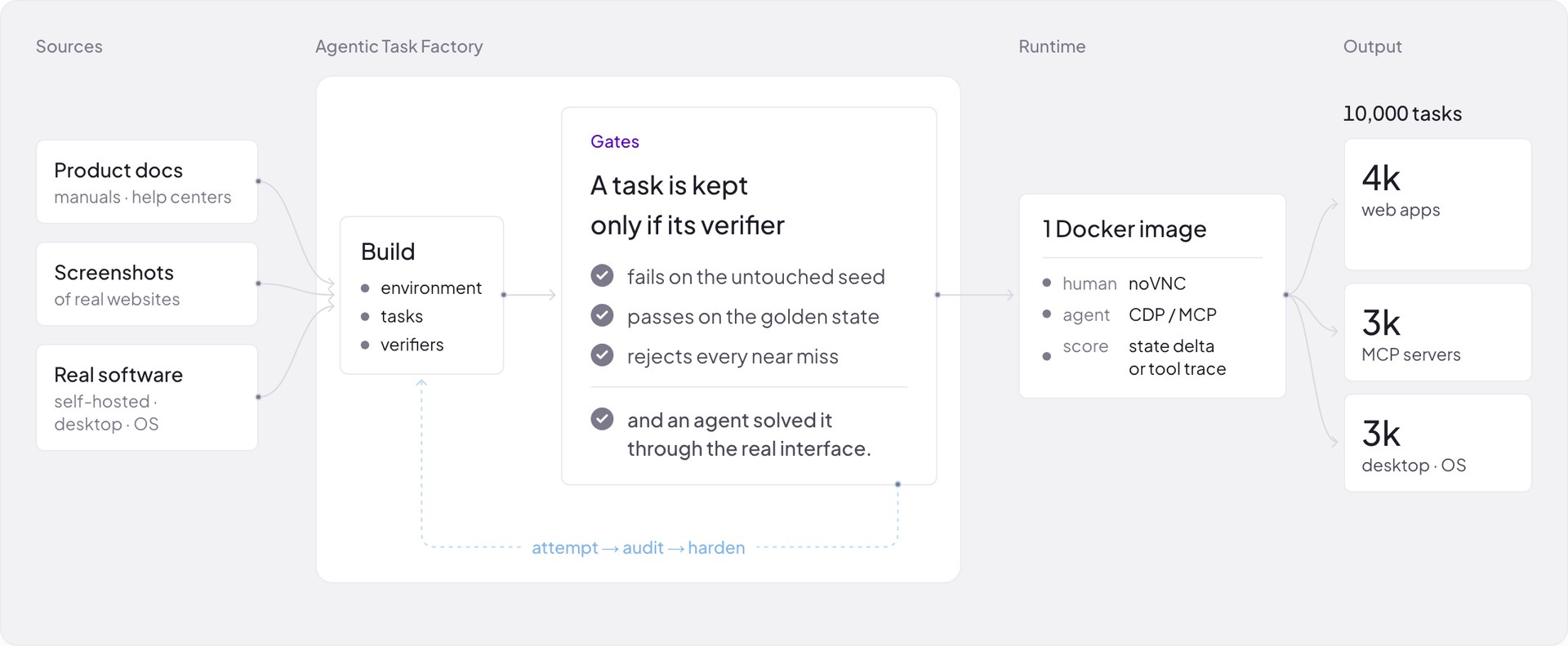
Changing interfaces changes the evidence
An API can return a structured success response. A screen may show a temporary notification that disappears. Code can create an artifact whose contents need inspection. An agent moving between these interfaces must verify progress using the evidence appropriate to each one.
Consider a hypothetical workflow that reads an order from an API and updates its delivery details through a web portal. The shared order identifier should be retained through every step. Matching only the customer’s display name creates an avoidable risk when multiple records look similar.
The workflow also needs a recovery rule. If a page times out after a submission, check whether the change already happened before submitting again. Repeating an apparently failed action can create duplicates when the original action succeeded but its confirmation was lost.
Use trajectories as a debugging resource
Published runs can help developers understand how an agent approaches a task, where it spends time, and which observations it relies on. They are particularly useful for identifying mistakes that an aggregate score conceals. A correct final result can still include unnecessary or risky intermediate actions.
When testing locally, keep a similar record of observations, actions, and resulting state. Review successful runs as well as failures. A fragile sequence that succeeds once may depend on timing or a screen layout that changes tomorrow.
Benchmark comparisons require care when task subsets, model versions, and execution environments differ. H Company explicitly described such differences in its cost-performance discussion. Use the results to identify candidates and inspect behavior, then reproduce the work that matters to the intended deployment.
Holo4’s release broadens the available tools for mixed-interface automation. Its practical value will depend on reliable identity matching, state verification, and recovery across those interfaces. Those are the conditions that turn a sequence of plausible actions into a dependable business workflow.
Have a correction or a useful perspective?
Get in touch with the publication.