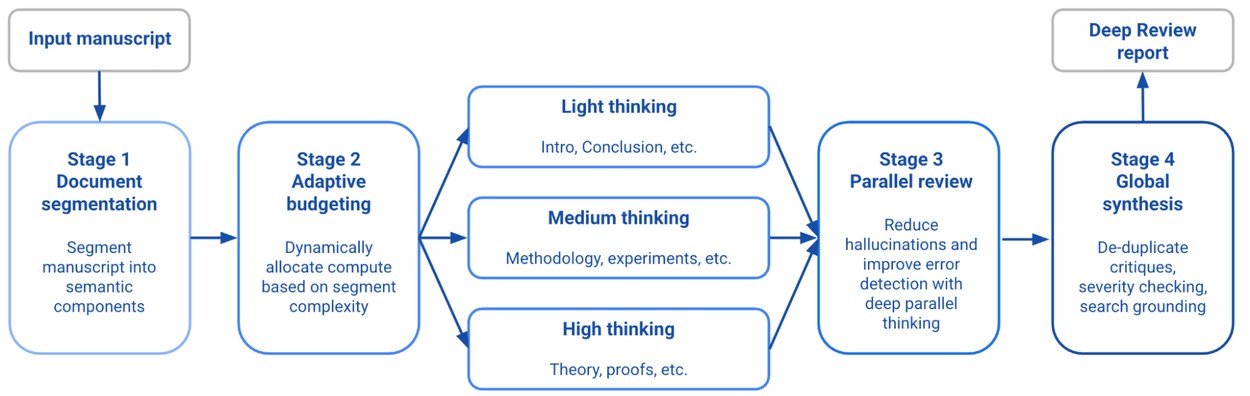
Google publicly launched Deep Review on October 14, extending a system developed for scientific manuscript feedback to a wider range of technical documents. Google says earlier pilots supported more than 16,000 opted-in manuscripts. The initial public release accepts PDFs and plain text, with two complimentary reviews per week and higher usage available through a Gemini API key.
The product addresses a familiar imbalance: drafting a long document can become much faster while checking its argument remains demanding. A reviewer needs to inspect claims, assumptions, calculations, and the relationship between evidence and conclusions. Improving the wording is only one part of that work.
Turn feedback into an investigation queue
A useful way to handle automated review is to classify each finding by the action needed. A missing definition can often be fixed directly. A numerical inconsistency requires recalculation. A claim that conflicts with other work needs a comparison of the underlying evidence. Grouping feedback this way prevents all comments from becoming equally urgent.
The author should retain the original passage and the reason for any change. Otherwise, a plausible automated objection can quietly replace a correct statement. Treat the review as a set of claims that can be inspected, rather than a verdict that a document has passed or failed.
Ask the system to work at the right level
A technical proposal can be internally consistent and still answer the wrong question. Before uploading it, state what decision the document is meant to support. For an engineering proposal, that might be a capacity decision under a stated load. For a research paper, it might be whether the experiments support a particular conclusion.
This framing helps distinguish a substantive flaw from an optional improvement. A reviewer can always request more experiments or more background. The important question is whether the missing material changes the decision the reader is being asked to make.
Confidentiality is part of the workflow
Google’s launch description says uploaded documents are not used to train its models and are retained for a year for display in the review interface. Teams should compare those stated terms with the documents they intend to submit. A service that is suitable for a public draft may require a different decision for unpublished or contract-restricted material.
Measure the system by verified issues found and review time saved, including the time spent dismissing incorrect findings. A shorter review is not necessarily a better one if it leaves a central argument unchecked.
Deep Review is most promising as a structured second reader. Its output can help authors direct scarce expert attention toward specific questions, while the responsibility for accepting a claim or publishing a correction remains with the people who own the work.
Have a correction or a useful perspective?
Get in touch with the publication.