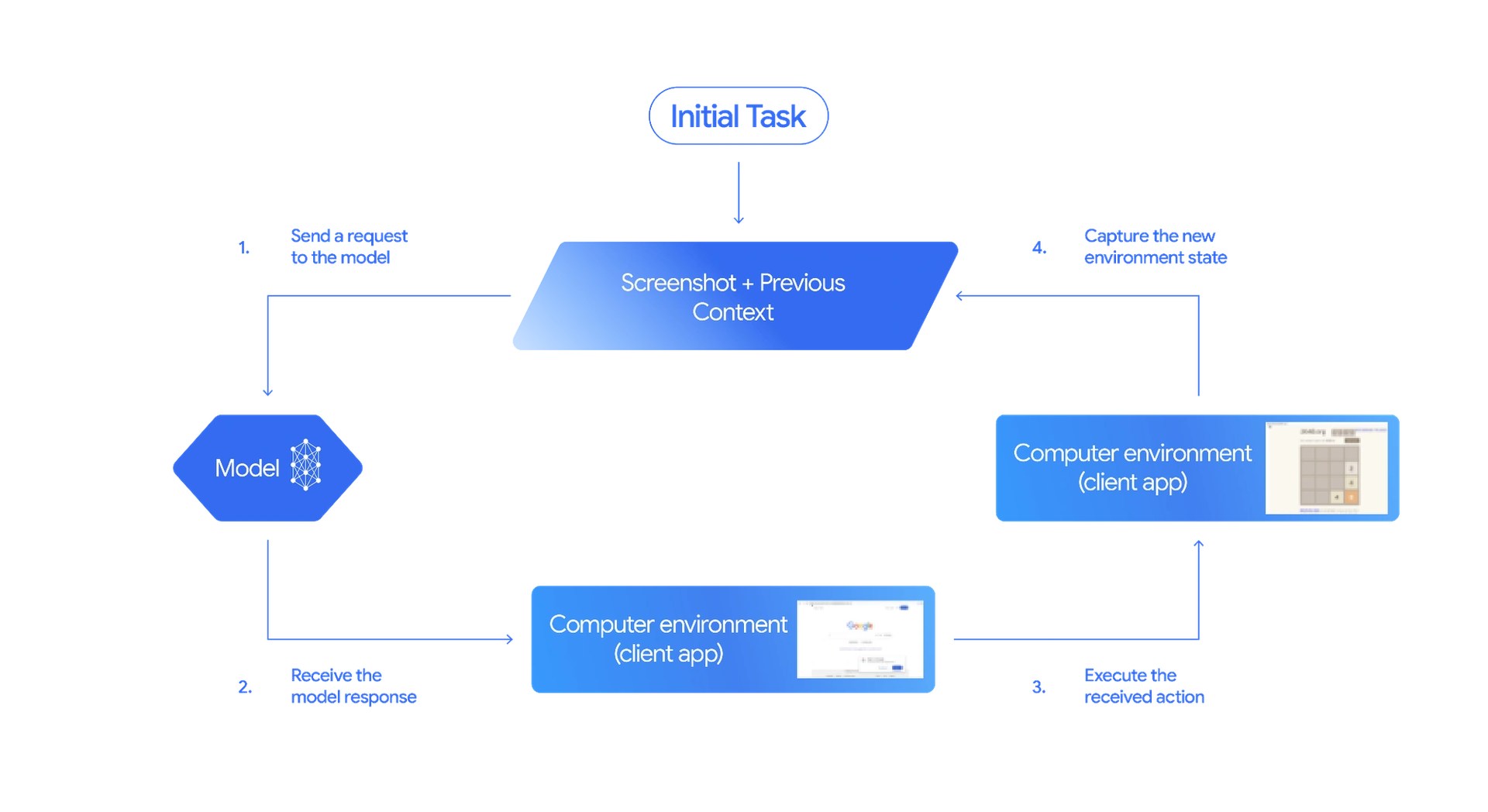
Google's Gemini API release notes announced that Computer Use reached general availability on October 30. The tool is available through both the Interactions and GenerateContent APIs, giving developers two supported integration paths for applications that act through an interface.
The release note is brief, and general availability should be read as a product milestone rather than a claim that every interface workflow is reliable. The engineering work remains in connecting observations to actions, checking whether the intended state was reached, and handling situations where the interface changes unexpectedly.
A click is an instruction with consequences
Screen-driven automation can work across software that lacks a convenient application programming interface. It must also reason from what is visible, which may be incomplete or temporarily stale. A button that occupied one location a moment ago may move after a dialog opens or a page finishes loading.
A robust workflow should verify the relevant state immediately before a consequential action and inspect the result afterward. If an agent intends to save a draft, the acceptance check should confirm that a draft exists in the expected place. Merely observing that the click executed is insufficient.
The same principle applies to recovery. When an action times out, repeating it may be harmless or may create a duplicate. The system needs a way to determine whether the first attempt took effect before trying again.
Choose bounded workflows first
An initial deployment should use a task with a clear start, finish, and allowed set of destinations. Exporting a report from a test account is easier to evaluate than unrestricted browsing across several authenticated services. Limited scope makes failures easier to reproduce and measure.
Keep sensitive or irreversible actions behind an explicit decision point. The review should show what will change and where, using the current state of the interface. That gives a person a concrete action to assess instead of a broad request to trust the remainder of a session.
Performance testing should include changed window sizes, unexpected dialogs, slow responses, and empty results. These ordinary variations often determine whether automation can operate reliably outside a demonstration.
The general-availability milestone makes Computer Use a more established building block for Gemini applications. The strongest implementations will combine that capability with precise state checks, recoverable steps, and a definition of success that refers to the application's actual outcome.
Have a correction or a useful perspective?
Get in touch with the publication.