
Introduction
Why Online Tools Don’t Automatically Create Success
Many beginners search for better online tools because they feel something is missing. Traffic is low. Sales are inconsistent. Growth feels slow. The assumption is simple: if the right tool is installed, results will improve.
But that belief often leads to frustration.
Online tools include AI writing assistants, automation software, analytics dashboards, content schedulers, email platforms, and digital marketplaces. These tools are powerful. They can speed up work, organize data, and expand reach. Yet they do not think, plan, or decide on their own.
A common beginner mistake is believing that access to advanced tools guarantees success. In reality, tools amplify what already exists. If your strategy is unclear, automation will scale confusion. If your message lacks clarity, AI will produce more of the same.
The core truth is simple: tools strengthen systems and decision-making. They do not replace them.
This idea connects closely with the broader relationship between technology and digital work, which we explain in our guide on Technology and Online Business – A Complete Beginner’s Guide.
In this article, we will examine the most common mistakes beginners make when using online tools—and more importantly, how to correct them with practical, realistic adjustments.
Mistake1 – Using Tools Without a Clear Strategy

One of the most common beginner mistakes is using online tools without a defined direction. The search intent behind this issue is simple: people expect tools to produce results, but they often skip the planning phase. The result is confusion instead of progress.
Tools Without Direction Create Noise
When beginners discover new AI tools, automation apps, or content platforms, they often try many at once. They follow trends, test features, and stay busy experimenting. But activity is not the same as advancement.
Without a clear objective, tools create digital noise. You might publish content, automate emails, or track analytics, yet still feel stuck. Jumping between platforms or strategies prevents depth. Instead of building momentum, energy gets scattered across too many directions.
Many beginners experience this confusion because they misunderstand how digital systems support online work. We explore this concept further in How Technology and Online Business Work Together.
How to Fix It: Define the Outcome First (80–100 words)
The solution is simple but powerful: define the goal before selecting the tool. Ask, “What result am I trying to achieve?” More traffic? Better organization? Higher conversion?
Once the outcome is clear, choose tools that support a system designed around that goal. Strategy comes first. Tools come second. When tools serve a defined process, they amplify progress instead of distracting from it.
Mistake 2– Relying on Automation Too Early

Automation is powerful, but timing matters. Many beginners try to automate everything before they truly understand what they are doing. The result is usually confusion, not efficiency. When a process is unclear, automation simply scales the confusion.
Online tools can send emails, schedule posts, or generate content. But if you do not understand your audience, your message, or your offer, automation will not fix that. It may even make the problem harder to notice. Before building systems, you need clarity.
Automating Before Understanding the Process
A common example is automating marketing without knowing who the audience is. Beginners set up email sequences without understanding what their readers actually need. They use ready-made templates without adjusting tone, structure, or context.
Copy-paste workflows feel productive, but they often lack strategy. Automation cannot replace thinking. If the core message is weak, automating it only spreads the weakness faster.
How to Fix It: Master the Manual Phase First
The solution is simple but not always easy. Start manually. Write emails yourself. Talk directly to early customers. Test small campaigns and observe results carefully.
When something works consistently, then automate that specific part. Automation should protect proven processes, not replace learning. Master the fundamentals first. Then use tools to increase speed and consistency — not to skip understanding.
Mistake 3 – Tool Overload and Constant Switching

The Productivity Illusion
Many beginners believe that trying more tools means making more progress. They download multiple apps, subscribe to several platforms, and test every new feature they discover. At first, it feels productive. There is movement, setup, and constant experimentation.
But activity is not the same as progress.
When workflows are spread across too many tools, systems become fragmented. Files are stored in different places. Data does not connect. Time is lost switching between dashboards. Instead of building momentum, the work becomes scattered and harder to manage.
The result is mental clutter. And mental clutter slows execution.
How to Fix It: Build a Minimal Tool Stack
Think of tools like a toolbox. Owning twenty tools does not make someone a skilled builder. Skill comes from knowing how and when to use a few tools well.
Start by choosing three to five core tools that handle your essential needs — communication, content creation, organization, and analytics. Make sure they integrate smoothly. Depth matters more than variety.
Learn each tool properly. Build clear workflows. Refine them over time.
When your systems are simple and connected, your focus improves. And when focus improves, real progress begins.
Mistake 4– Ignoring Data and Feedback

One of the most common beginner mistakes when using online tools is working blindly. Content is published. Campaigns are launched. Emails are sent. But nothing is measured. When results are disappointing, the reaction is often emotional rather than analytical.
Online tools generate valuable data. Website dashboards show traffic sources. Email platforms track open rates. Sales systems reveal conversion numbers. Ignoring this information means ignoring direction.
Without feedback, effort becomes repetitive instead of progressive. You may continue producing content that attracts visitors but does not convert. Or you might spend time improving design when the real issue is unclear messaging.
Data is not there to intimidate beginners. It exists to guide improvement. When used correctly, it transforms guesswork into informed decisions.
Creating Without Measuring
Many beginners create consistently but rarely check performance reports. Analytics remain untouched. Conversion rates are never reviewed. Decisions are based on assumptions rather than evidence.
Guessing feels faster in the short term. However, it slows growth over time. Without measurement, you cannot identify strengths or weaknesses. You may repeat ineffective strategies simply because you never evaluated them.
Online tools provide insights for a reason. Ignoring them removes one of the biggest advantages of working online.
How to Fix It: Use Data to Guide Improvement
The solution is not complicated. Start by reviewing performance regularly, even once per week. Look at basic metrics: traffic sources, engagement time, conversion percentages.
If a blog post gets views but no sign-ups, adjust the call-to-action. If emails are unopened, test clearer subject lines. Improve one variable at a time.
Small adjustments compound. Over months, data-driven improvements create measurable progress. In this way, feedback turns effort into informed growth rather than repeated guessing.
Mistake 5 – Expecting Instant Results from Tools

Many beginners assume that once they start using modern online tools, results will come quickly. This expectation often leads to frustration. Tools can improve efficiency, but they do not remove the need for learning, testing, and refining.
When progress feels slow, it is easy to blame the tool. In reality, the issue is usually deeper. Growth depends on skill, clarity, positioning, and consistency. Tools simply make those elements easier to apply — they do not create them automatically.
Tools Are Accelerators, Not Magic
AI writing tools can speed up drafting. Marketing automation platforms can organize email sequences. Design tools can simplify visuals. But none of these guarantee engagement, sales, or long-term success.
An accelerator increases speed. It does not choose the direction. If the strategy is unclear, faster execution only spreads confusion more quickly. Without understanding the audience or refining the message, even advanced tools produce average results.
How to Fix It: Focus on Skill Development
Instead of chasing faster results, invest in improving thinking and communication. Learn how to write clearly. Understand your audience’s real problems. Refine your message over time.
Practice builds depth. Depth creates trust. When skills improve, tools become more powerful because they amplify something strong. Growth still requires patience and consistency, but tools then serve as support rather than false promises.
Mistake 6 – Neglecting Security and Organization

When beginners start using online tools, they often focus on growth and ignore protection. Security and organization may feel boring compared to marketing or content creation. But weak systems create long-term risk.
Online business depends on digital assets — accounts, files, customer data, and payment systems. Without structure, small mistakes can become serious problems.
Disorganized Systems Create Risk
Using weak passwords across platforms increases the chance of account breaches. Not creating backups can lead to lost work. Poor file management wastes time and causes confusion.
Many beginners only realize the importance of security after something goes wrong. By then, recovery is stressful and sometimes expensive. Disorganization also slows productivity, because time is spent searching for files or fixing avoidable issues.
How to Fix It: Build Safe and Structured Systems
Start with simple protection. Use a password manager to generate and store secure passwords. Enable two-factor authentication where possible. Schedule regular backups of important files.
Create clear folders and naming systems. Document basic workflows so tasks are repeatable. These small steps create stability. Over time, organized systems reduce stress and protect long-term progress — which is essential for sustainable online growth.
A Simple Framework – Purpose → Process → Tools → Optimization
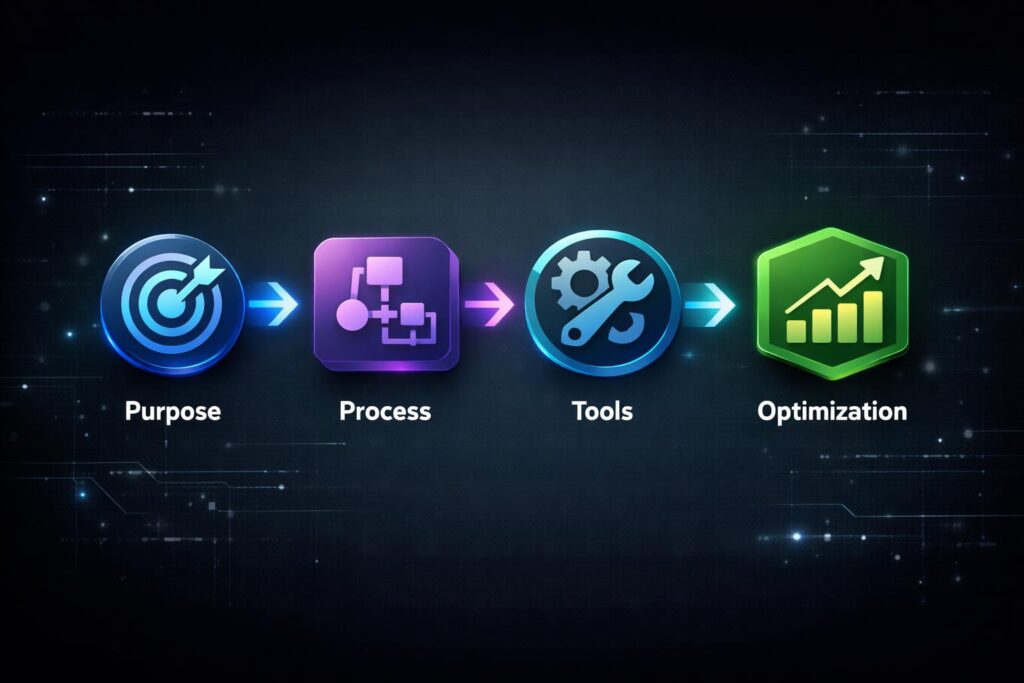
Beginners often get stuck because they start with tools instead of direction. A clearer way to think about online work is this simple sequence: Purpose → Process → Tools → Optimization. When followed in order, it prevents confusion and reduces dependency on constantly searching for new apps. Each step builds on the one before it. Skip one, and the system becomes unstable.
Purpose Comes First
Every productive system begins with a clear goal. What exactly are you trying to achieve? More leads, better content quality, faster delivery, higher conversions? Without a defined outcome, tools become distractions. Purpose creates focus. It filters decisions and prevents random experimentation.
Process Comes Second
Once the goal is clear, outline the steps required to reach it. This is your workflow. For example, content creation may involve research, drafting, editing, publishing, and promotion. When the process is mapped out, weaknesses become visible. Improvement becomes practical instead of emotional.
Tools Support the Process
Only after defining the workflow should tools enter the picture. A scheduling app supports publishing. An analytics dashboard tracks results. A design platform improves visuals. Tools should fit into the system, not dictate it. Owning advanced software without structure rarely improves outcomes.
Optimization Through Data
The final step is refinement. Review results. Adjust steps. Remove friction. Small improvements compound over time. Data transforms effort into informed progress, making growth steady rather than chaotic.
Practical Guidelines for Beginners
When starting with online tools, progress does not need to be dramatic to be meaningful. In fact, calm and structured growth is often more sustainable than fast experimentation.
Begin small. Choose one clear objective and support it with a limited number of tools. Instead of testing five different platforms at once, learn one tool deeply. Understanding its features, limits, and best practices will give you more value than shallow familiarity with many options.
Avoid unnecessary subscriptions in the early stages. Many tools offer free plans that are more than enough for beginners. Upgrade only when your needs clearly justify the cost.
Track performance weekly, not obsessively. Review simple metrics that relate to your goal—traffic, engagement, conversions, or task completion. Small adjustments made consistently lead to meaningful improvement over time.
Most importantly, improve gradually. Online growth is a structured process. Steady refinement, not constant switching, builds confidence and long-term stability.
Frequently Asked Questions (FAQ)
Do I need many tools to succeed?
No. Most beginners succeed with a small set of well-chosen tools.
What matters is how clearly you use them, not how many you collect.
A focused system with a few reliable tools is usually more effective than a complex stack you barely understand.
Are paid tools better than free ones?
Not always. Many free tools are powerful enough for beginners.
Paid tools often add convenience, automation, or advanced features.
Upgrade only when your needs outgrow the free version — not before.
Can AI replace human skill?
No. AI can assist with speed and efficiency, but it does not replace judgment, creativity, or strategy.
Strong results still depend on human thinking, clear communication, and informed decisions.
How do I know if a tool is worth keeping?
Measure results. Does it save time, improve quality, or increase performance?
If a tool adds complexity without clear benefits, it may not belong in your system.
Conclusion – Tools Are Powerful, But Strategy Wins
Online tools are powerful. They can save time, increase efficiency, and simplify complex tasks. But tools alone do not create results. Without clear goals, structured systems, and consistent effort, even the best software becomes noise.
The key lesson is simple: build the system first, then choose the tools that support it. Strategy comes before automation. Skill comes before scale. Consistency matters more than constant experimentation.
Beginners who focus on learning fundamentals, organizing their workflow, and improving step by step will always have an advantage over those chasing shortcuts. Tools amplify what already exists. If the thinking is clear, results improve. If the foundation is weak, technology only magnifies confusion.
Long-term success online is not about owning more tools. It is about using the right ones with purpose. Move calmly, build carefully, and let strategy lead every decision.




3 Comments on “Common Mistakes Beginners Make When Using Online Tools (And How to Avoid Them)”