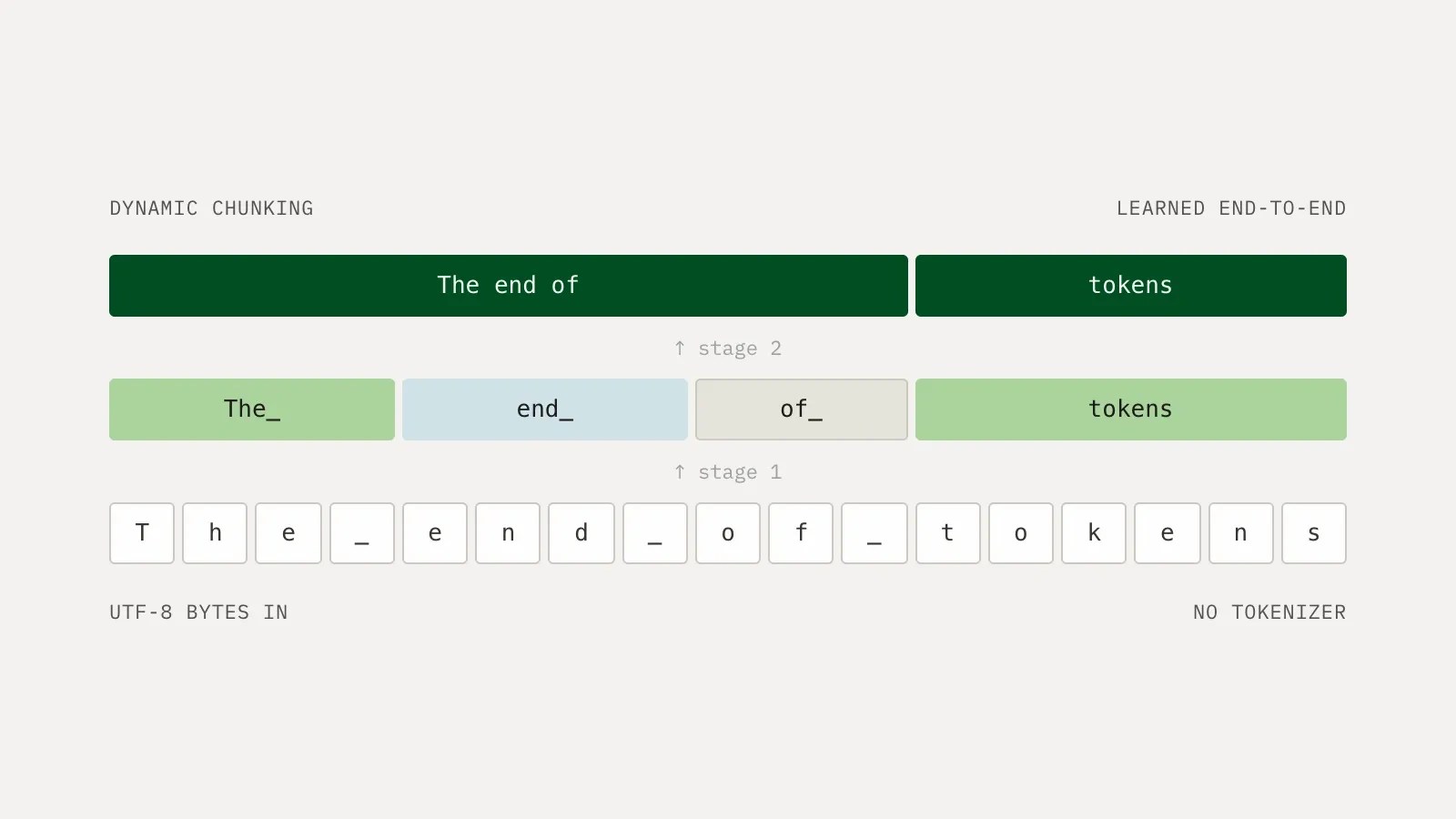
Cartesia published new research on hierarchical networks, or H-Nets, which learn how to group raw input rather than relying entirely on a fixed tokenizer. The work examines whether learned chunking can make language modeling more efficient as models and training runs scale.
The report includes controlled comparisons with tokenized Transformer baselines and experiments with a larger, two-stage hierarchy. Cartesia reports efficiency gains and describes patterns in how the models group information, including behavior that changes with context. The research also discusses potential applications beyond language, including biology and vision.
The boundary between data and model is moving
A tokenizer decides how text is broken into units before a language model processes it. That decision influences how many units a sequence requires and which patterns the model sees. Learning the grouping inside the system creates the possibility of adapting those units to the data.
The interesting question is broader than whether one familiar word uses fewer pieces. A learned representation may discover useful structure in unfamiliar languages, code, or specialized symbols. It may also introduce behavior that is harder to predict from a simple token-counting rule.
For researchers comparing architectures, training conditions are crucial. Data quantity, data mixture, compute accounting, and baseline quality can all change the apparent advantage. A convincing result should make it possible to separate the benefit of the representation from other improvements in the experiment.
Efficiency has more than one destination
Better training efficiency does not automatically translate into faster interactive serving. The path from an architectural idea to a production system includes kernel support, batching behavior, memory use, and the cost of handling variable-length inputs. Those should be measured independently when implementations become available.
Evaluation should also include unusual inputs. Structured identifiers, mixed scripts, indentation-sensitive code, and repeated patterns can expose differences that disappear in an average language score. A model intended for practical tools must preserve exact information as well as broad meaning.
For application developers, the research is a reason to avoid treating today's tokenization conventions as permanent product assumptions. Usage estimates, context limits, and input validation may need to evolve if the underlying representation changes.
Cartesia's work adds evidence to an architectural question with substantial consequences: how much of the input representation should be designed in advance, and how much should be learned? The next useful evidence will connect the reported scaling behavior to reproducible results and the demands of real serving workloads.
Have a correction or a useful perspective?
Get in touch with the publication.

