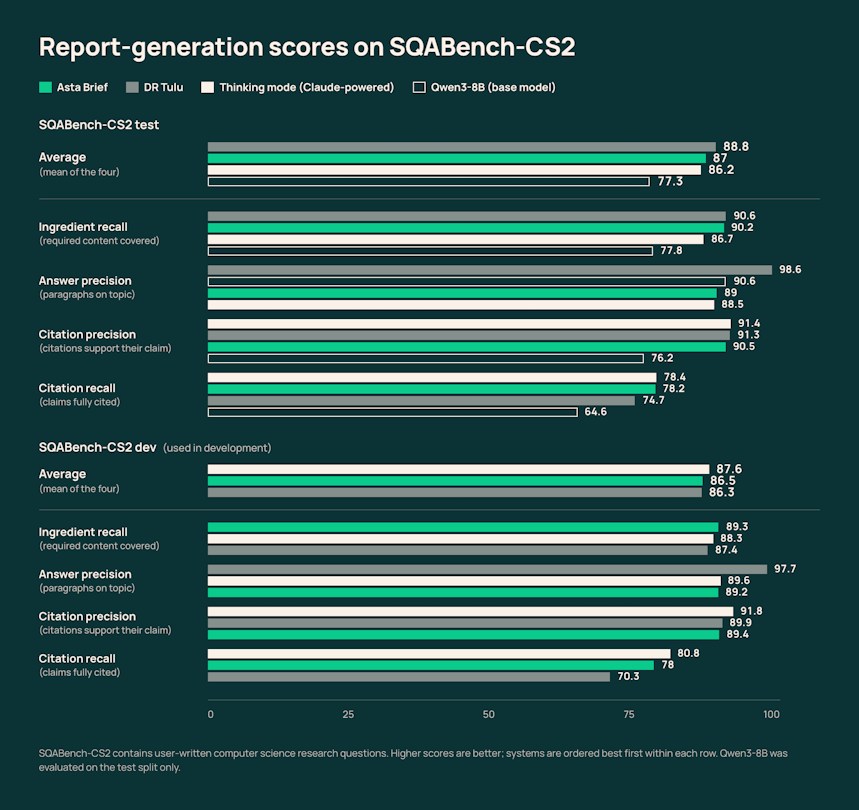
Ai2 released AstaBrief 8B on October 2, a model based on Qwen3-8B that turns a research question and retrieved literature excerpts into a report with citations. The model and training data were made available, and Asta offered it as a Fast mode alongside its Thinking mode. Ai2 said much of the training and evaluation had been completed in 2025 and had not been fully rerun against the latest frontier models.
That caveat is central to reading the release. It presents a useful specialized system and training approach, while its historical comparisons do not establish a current universal ranking. The more durable question is what a smaller model can do when the task and evidence pipeline are carefully defined.
A citation is the start of a check
A report can attach a real paper to a statement that the paper does not support. Review therefore needs to examine the relationship between each important claim and its cited evidence. Check the population, method, and conditions of the study, not just whether the title appears relevant.
For a literature comparison, separate direct findings from synthesis. The model may reasonably infer a pattern across several studies, but readers should be able to see which part is an inference. Conflicting results should remain visible instead of being smoothed into a convenient consensus.
Keep the retrieved excerpts and their document versions with the report. If a summary is later challenged, those records show what evidence the model actually received. They also distinguish a retrieval failure from a generation failure.
Use speed to support revision
A faster initial report can make an iterative research process more practical. A researcher can narrow the question, add missing constraints, or request a comparison by method. The benefit comes from better questions and checks between versions, rather than treating the first fluent output as finished scholarship.
Test local deployment with representative documents before assuming that open weights solve an institution’s needs. Data handling, retrieval quality, hardware, and document parsing remain part of the system. A model can be available to download while the full workflow still needs substantial integration.
Include negative and inconclusive studies in an evaluation set. A useful scientific assistant must preserve uncertainty and limitations, not merely generate convincing prose around positive findings.
AstaBrief’s release offers researchers a concrete system they can inspect and adapt. Its value lies in the combination of specialized training, accessible artifacts, and a workflow that keeps evidence review close to report generation.
Have a correction or a useful perspective?
Get in touch with the publication.