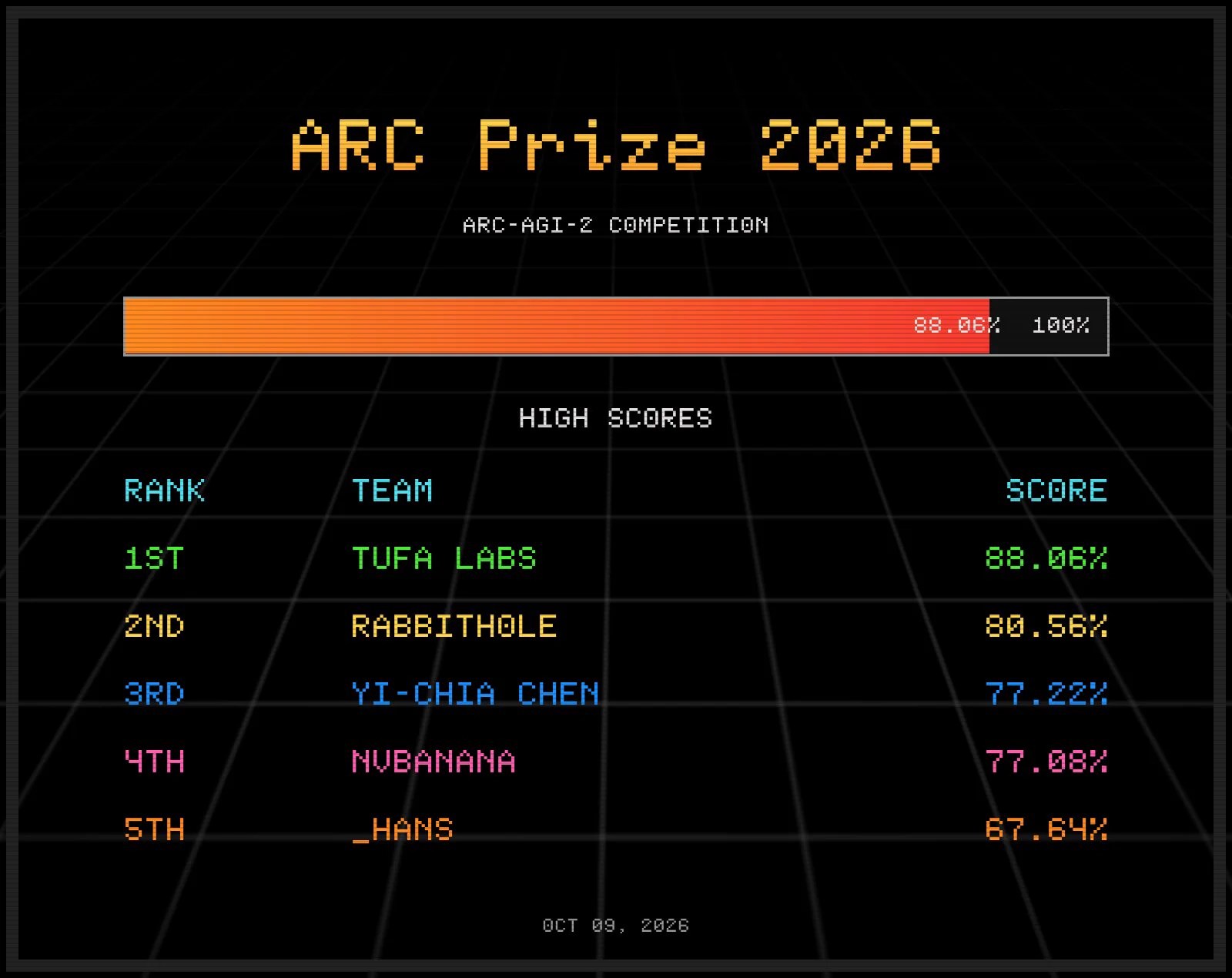
ARC Prize reported on October 9 that TUFA Labs had reached 88.06 percent on its ARC-AGI-2 high-score leaderboard. The announcement also noted an additional $150,000 bonus pool to be shared by teams scoring above 85 percent. The result clears that threshold and gives the competition a concrete new reference point.
It is tempting to turn a high reasoning score into a broad claim about intelligence. A more useful reading starts with the task being measured, the allowed resources, and the method that produced the answer. A leaderboard is evidence about performance under its rules. Its meaning becomes less precise when those rules disappear from the discussion.
A score needs a unit of comparison
Consider two hypothetical systems that reach similar accuracy. One makes many attempts and selects an answer; the other produces a single answer with a smaller compute budget. They may be equally successful on the scored problems while offering very different cost, latency, and deployment characteristics.
That is why readers should look for whether an entry represents one model or a larger solver, how much computation it uses, and which conditions are shared with earlier entries. These are questions to ask of the accompanying method, not assumptions to fill in from the final percentage. An absent detail is a limit on the comparison.
A demanding benchmark can reveal a capability that ordinary product demos miss. It can also encourage specialists to invest in methods that generalize beyond the competition. Neither benefit requires treating the benchmark as a complete inventory of what a system can do.
A product team has additional requirements: explaining a failure, responding within a usable time, and operating on inputs unlike the evaluation examples. For a document assistant, an excellent abstract-reasoning result does not establish accurate document retrieval. For a coding assistant, it does not establish that a change respects a project’s interfaces. Each application needs evidence connected to its own work.
What to watch after the threshold
The useful follow-up is the method and its reproducibility. Look for enough detail to understand the resource budget, the preparation process, and the separation between development material and evaluation problems. Independent reproductions can help distinguish a robust advance from a result that depends on a narrow configuration.
TUFA’s reported score is a substantial competition milestone. Its longer-term importance will depend on whether the ideas behind it produce reliable improvements under clearly stated conditions. Preserving that distinction lets readers recognize progress without asking a single percentage to answer every question about AI capability.
Have a correction or a useful perspective?
Get in touch with the publication.

