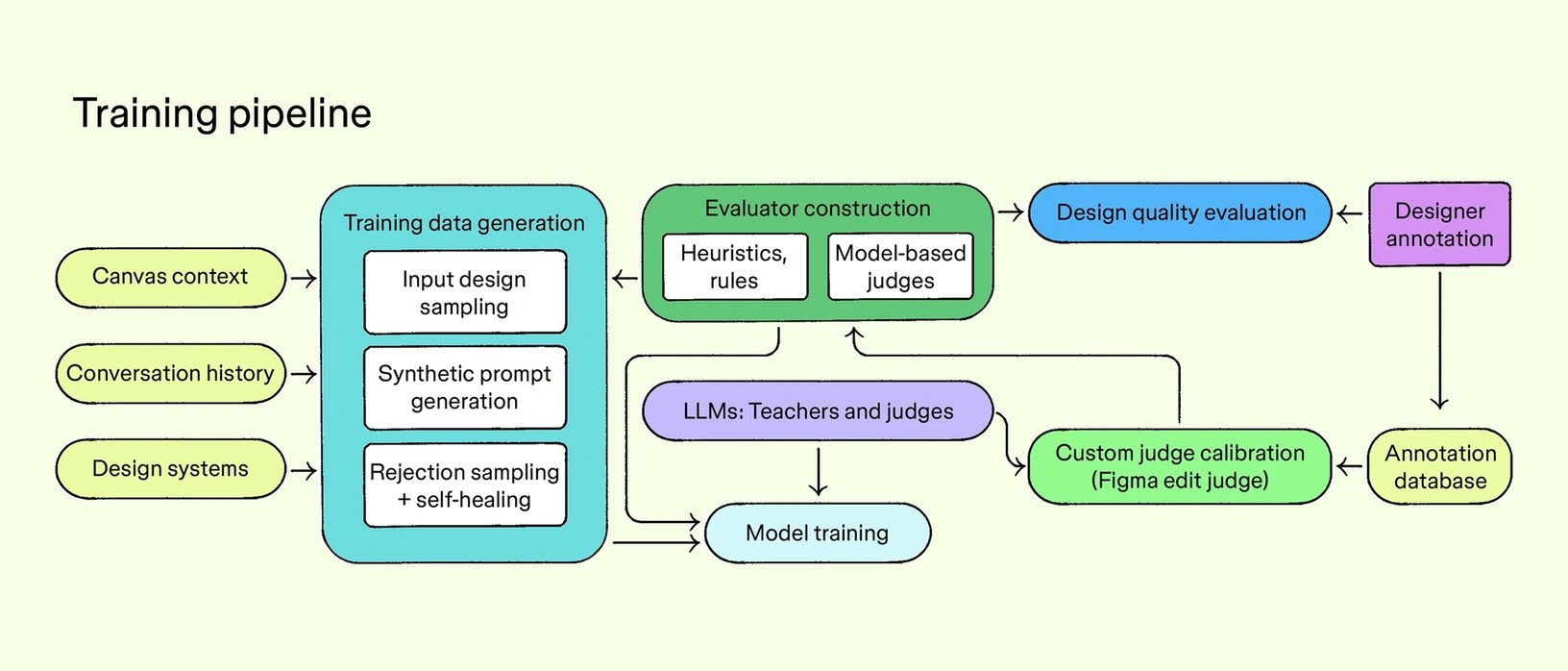
Figma described its work on a specialized model for editing designs already on the canvas. The approach uses examples in Figma's native format, synthetic edit requests, and evaluations that consider whether the requested change was made correctly.
The company initially used supervised fine-tuning and later expanded its work on reinforcement learning, evaluation environments, and expert-written criteria. Its account emphasizes that design quality has multiple dimensions: an edit can look polished while missing the instruction, using the wrong component, or disturbing content that should have remained unchanged.
Editing starts with a preservation problem
Generating a new screen gives a model broad freedom. Editing an existing one requires it to understand which parts of the design are already settled. The user asking for a spacing adjustment usually does not want a new color palette or a rewritten headline.
That makes change scope a useful evaluation target. Compare the requested modification with the actual set of altered elements. A successful edit should satisfy the request and leave unrelated decisions intact, unless the agent explains why another change is necessary.
Structure matters as much as appearance. A button can look correct while losing its connection to the design system. That may create maintenance work later when the team changes a shared component. Visual review and structural checks should therefore complement one another.
Build a test set from ordinary revisions
The most informative examples may be small, frequent tasks: align a group, replace a component variant, adapt a frame to another width, or correct text overflow. These edits are easy to recognize and often have clear acceptance criteria.
Include cases that tempt the model to overreach. Ask it to change one card in a repeated layout while preserving the others, or to adjust a theme without altering hierarchy. Such tests reveal whether the model understands the boundary of the request rather than merely producing something attractive.
Speed should be measured in the context of the designer's flow. An edit that requires several rounds of clarification can interrupt work even if each individual generation is fast. Time to a usable result is a better measure than raw inference latency.
Figma's research points toward AI assistance that operates inside an established design system. Its value will come from making routine changes dependable, preserving the decisions a team has already made, and leaving designers with a clean artifact they can continue to edit.
Have a correction or a useful perspective?
Get in touch with the publication.

