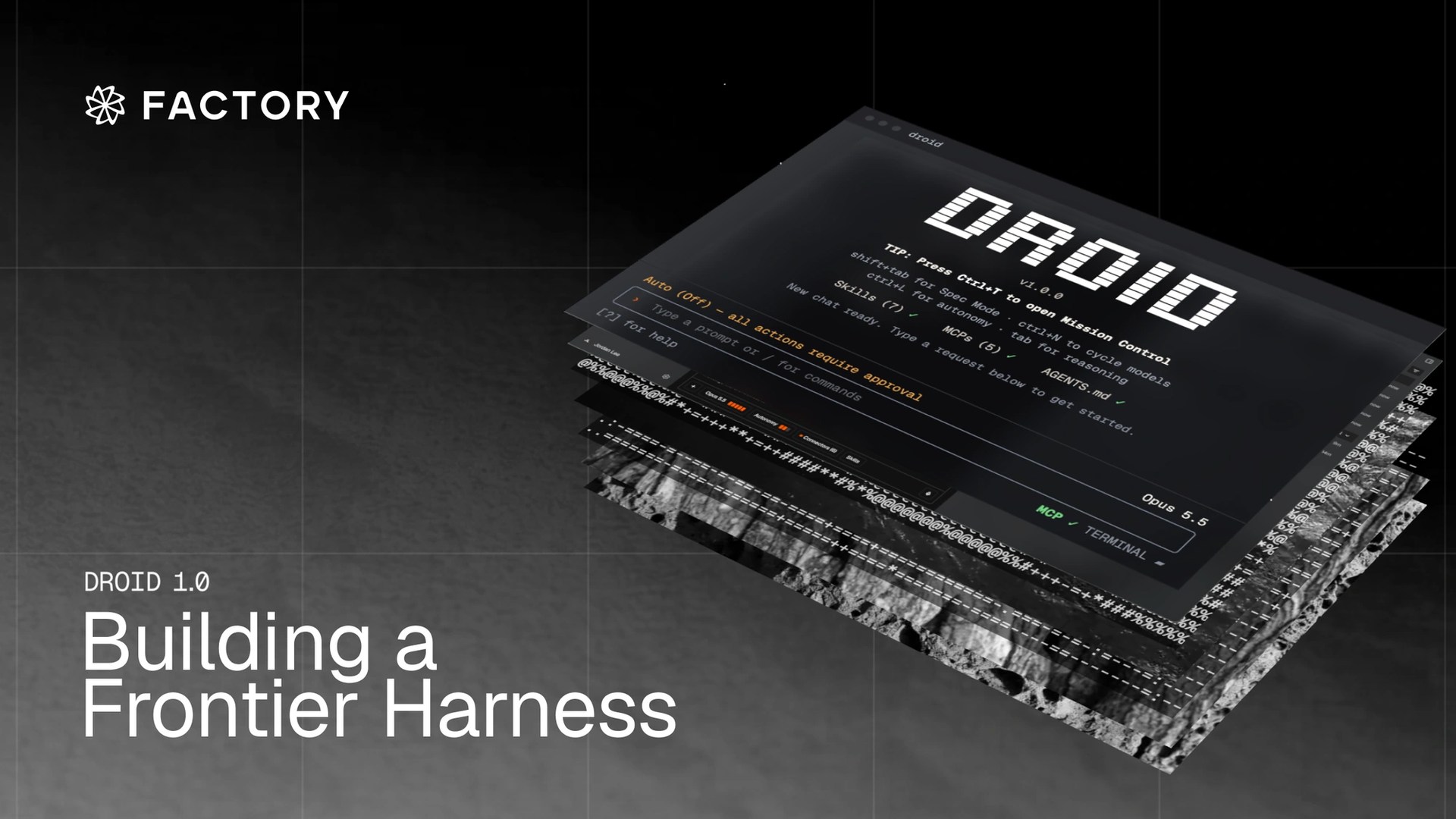
Factory introduced Droid 1.0, a major update to the harness behind its coding agent. The announcement centers on programmatic tool calling, which lets a model express a larger workflow as code instead of returning to the model for every individual operation.
Factory describes a model-independent system and an internal process in which agents investigate failures, propose changes, and test them across model families before engineers decide what ships. The company reports efficiency gains in its own comparisons. Those results make the harness a meaningful part of the performance story, alongside the choice of model.
Fewer round trips change the failure surface
When an agent can organize several tool operations together, it may avoid repeatedly sending large instructions and histories back to the model. That can reduce waiting and duplicated context. It also means that more work may occur between moments when the model or user can reconsider the plan.
A practical evaluation should inspect how the system behaves when the third step in a longer sequence fails. Does it stop, continue with incomplete information, or repeat an earlier side effect? The answer matters more than the smooth execution of the ideal path.
Some operations can be safely retried because they only read information. Others create a branch, send a request, or modify a file. The harness should preserve enough structure to distinguish those cases, especially when a workflow resumes after an interruption.
Efficiency must preserve useful evidence
A faster tool sequence is easier to trust when its intermediate results remain inspectable. Developers need to know which commands ran, which files changed, and which checks supported the final conclusion. Compressing orchestration should not compress away the information required for review.
Cross-model testing is also valuable because an optimization can depend on a particular model's habits. A change that reduces unnecessary calls in one family may cause another to skip a needed verification step. Evaluate the same accepted outcome across several representative tasks rather than treating a lower call count as an automatic improvement.
For teams considering Droid 1.0, an effective trial would include a routine repair, a task with several dependent tools, and a task that must recover from a controlled failure. Compare the cost of a completed, reviewed change in each case.
Factory's announcement strengthens the argument that agent performance is a property of the whole execution system. The useful gain is more work completed with fewer wasted steps, while keeping the boundaries and evidence clear enough for a developer to remain accountable for the result.
Have a correction or a useful perspective?
Get in touch with the publication.