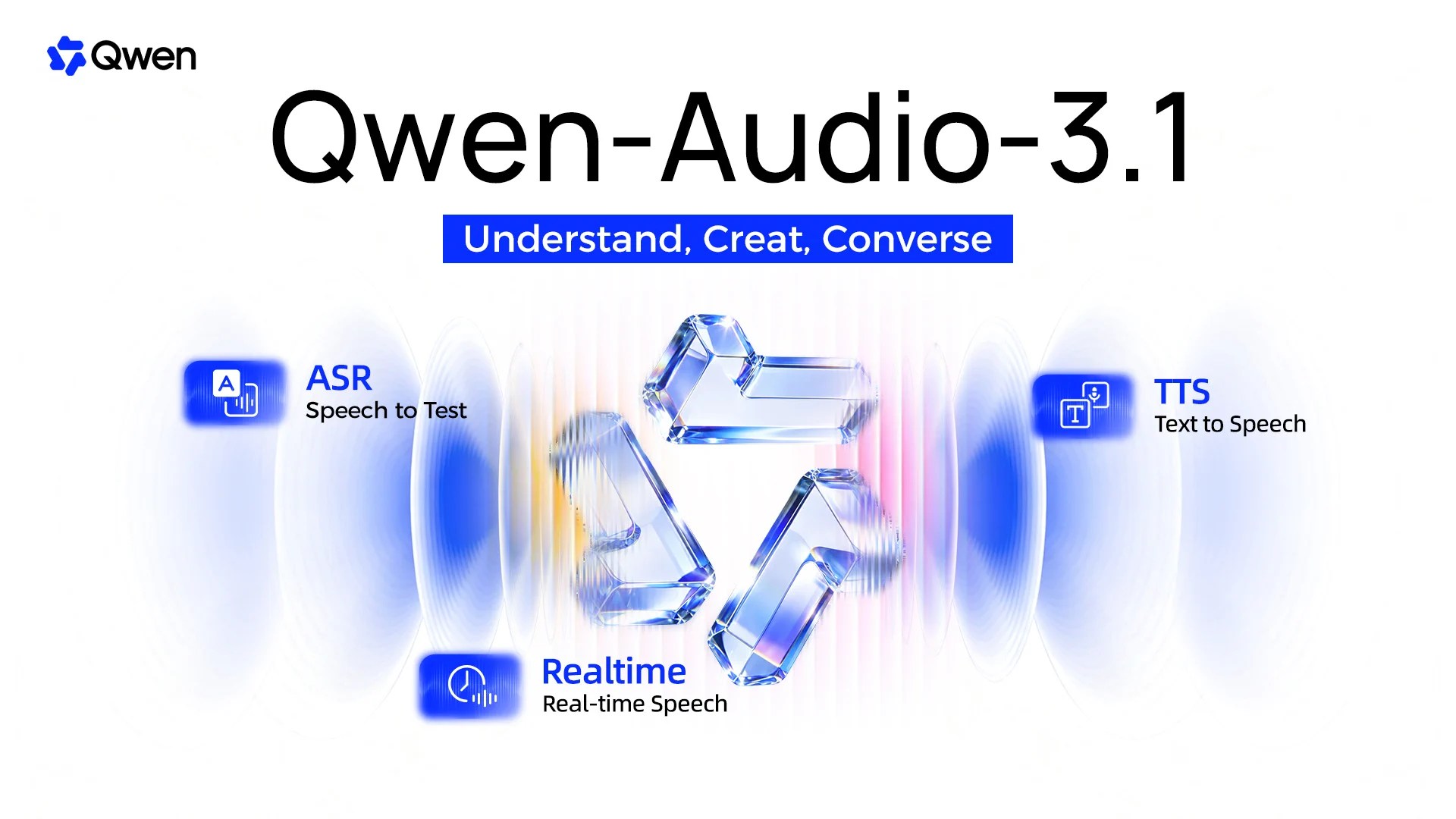
Qwen announced the Audio 3.1 family on September 23, updating ASR, TTS, and Realtime models and adding TTS-Next and ASR-Next. The announcement described a range spanning speech recognition, speech generation, live interaction, and combined voice, sound-effect, and background-audio creation. It also highlighted speaker labels and timestamps in ASR-Next.
A broad audio lineup can simplify procurement, but it does not make the components interchangeable. A meeting archive, a live assistant, and an audiobook have different definitions of a good result. Choosing a model begins with deciding which information the application must preserve.
Faithful and polished are different outputs
Qwen described native transcript polishing that removes fillers and repetitions. That can improve readability for a summary or article draft. In an interview record, however, a hesitation, repetition, or correction may matter. Keep the original audio and distinguish a cleaned transcript from a faithful record.
Speaker labels create another verification task. A transcript can contain the right words but assign them to the wrong person. Test interruptions, overlapping speech, and speakers with similar voices. Treat uncertain attribution as uncertain instead of silently assigning every sentence.
Timestamps should be checked at the boundaries the product uses. A searchable archive needs links that lead listeners to the relevant passage. A subtitle system needs timing that remains readable. The same timestamp output can perform differently in those two applications.
Give live interaction its own evaluation
A conversational system needs to handle interruption and correction. Test whether it stops speaking when the user takes a turn and whether it updates its interpretation when a sentence changes direction. A realistic evaluation includes network delays and imperfect microphones.
Do not infer a person’s emotional state with certainty from a model’s audio description. Tone can be ambiguous, culturally variable, or affected by recording conditions. If the application adjusts its response style, keep that adjustment modest and avoid turning an uncertain signal into a consequential judgment about the speaker.
For creative generation, preserve separate versions of the script and production instructions. Listen for missing words, unintended additions, and background sound that obscures important speech. A coherent audio track still needs editorial review.
Qwen Audio 3.1 gives builders more specialized options within one family. The useful decision is to map each option to an explicit output contract: what must be retained, what may be transformed, and what a reviewer will check before the result reaches a user.
Have a correction or a useful perspective?
Get in touch with the publication.

