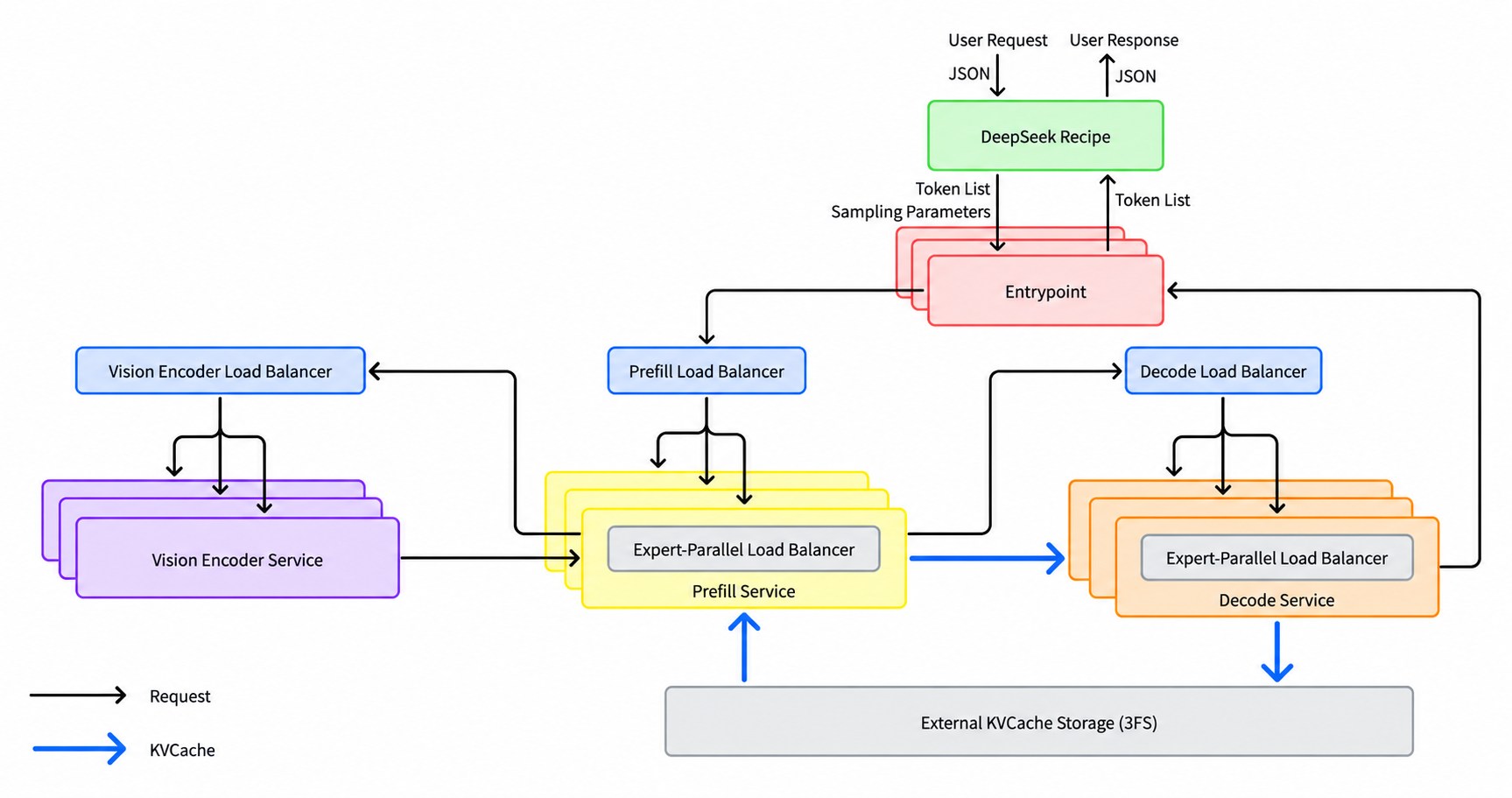
DeepSeek announced the open release of DeepInfer on October 20, alongside its deepseek-recipe token encoding and decoding component. The DeepInfer repository describes an inference framework used in DeepSeek’s large-scale production systems. The public release provides offline inference and core features for running DeepSeek models at scale under Apache 2.0.
The repository also states what is not included in a complete service: a KV cache system, some disaggregation infrastructure, and load balancing across replicas. That boundary is important. Releasing a production-derived engine gives developers valuable building blocks, but it does not automatically reproduce the provider’s entire hosted platform.
The engine is one part of the request path
A user-facing inference service must receive requests, manage capacity, run the model, and deliver results while handling interruptions. It also needs to decide what happens when demand exceeds available resources. An optimized engine can improve the central computation while leaving these surrounding responsibilities to the operator.
A team evaluating DeepInfer should start by drawing that request path and marking the components it already has. If authentication, queueing, observability, and replica management are mature, a new engine may be a focused integration. If those systems are absent, the project is closer to building a serving platform than swapping a library.
Compatibility includes token interpretation
The accompanying token-processing component is relevant because a model does not receive an application’s messages as abstract conversation objects. Those messages must be encoded into the form the model expects. Differences in formatting, special tokens, or tool representation can change behavior even when the same weights are used.
For a comparison, keep representative requests that include ordinary chat, tool interactions, and structured output. Inspect the final result and the request formatting together. A performance gain is less useful if the new path interprets the application’s conversation differently.
Reproducibility needs a controlled workload
The public framework includes features aimed at deterministic and batch-invariant behavior under supported configurations. These can be valuable for debugging, but their conditions should be checked rather than assumed. Record hardware, runtime settings, sampling parameters, and the model checkpoint when investigating a difference.
Use a workload that represents the intended service, including long inputs and simultaneous requests. Measure successful completion, queueing, and recovery alongside generation speed. A team should be able to explain both the improvement and the operational responsibilities it takes on.
DeepInfer’s release is significant because it exposes more of a large-scale inference implementation. Its most useful starting point is the repository’s explicit boundary: understand what the engine provides, then budget for the remaining service components needed to make that capability reliable for users.
Have a correction or a useful perspective?
Get in touch with the publication.