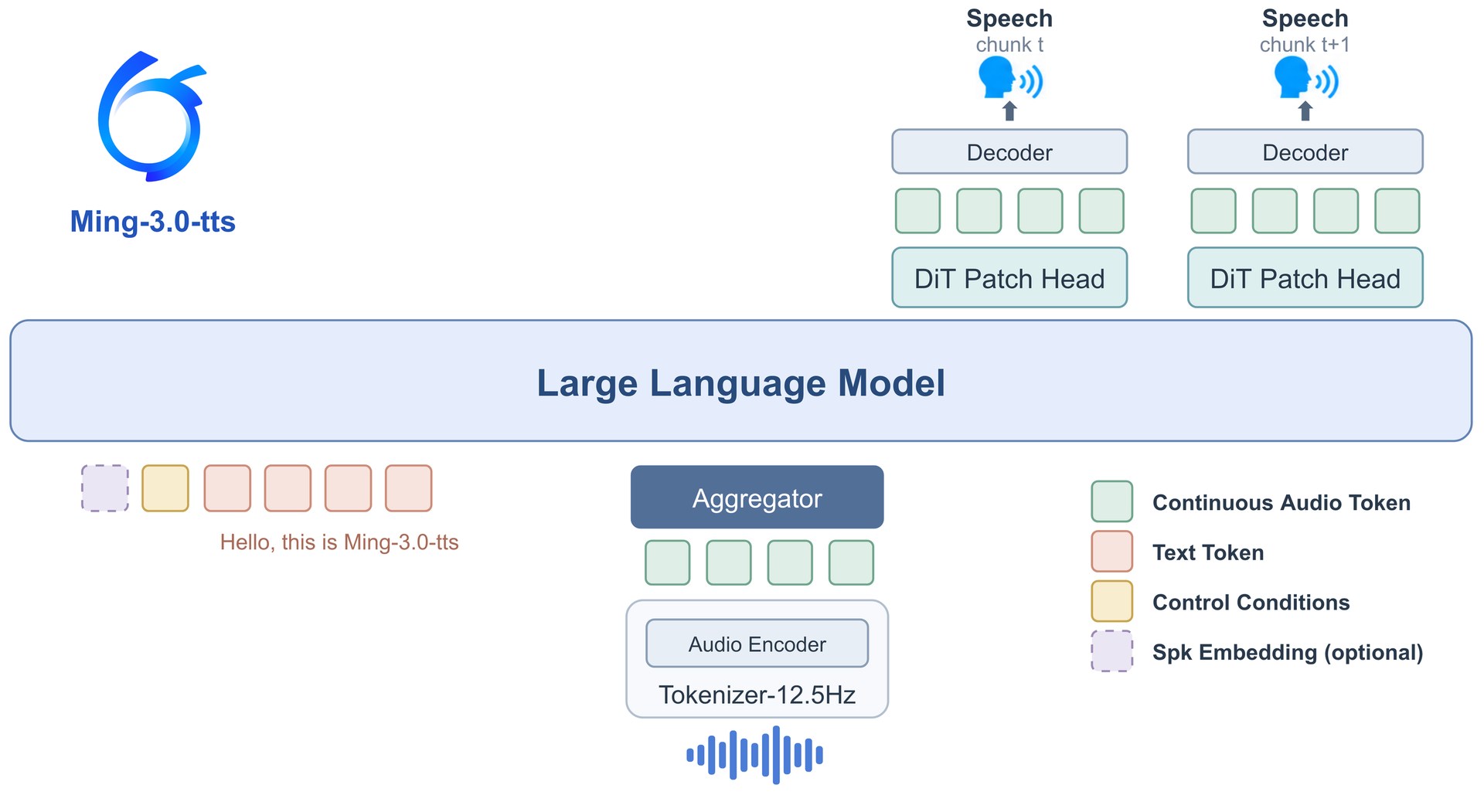
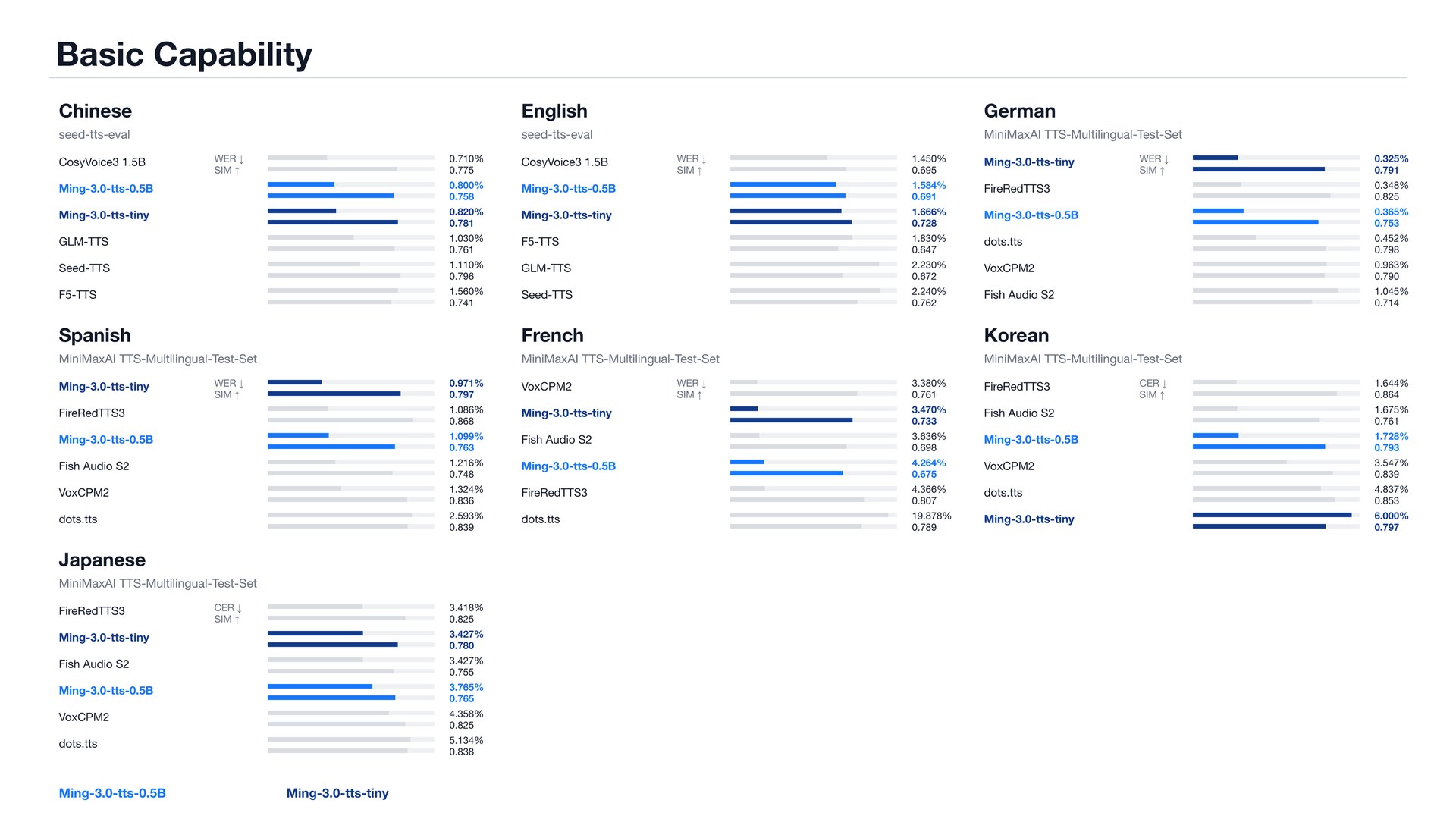
inclusionAI released Ming-3.0-tts, a speech-generation family with a 0.5-billion-parameter dense model and a larger mixture-of-experts variant called tiny. The repository describes the latter as having 7.9 billion total parameters and 1.3 billion active parameters. The project provides weights and inference code under an MIT license.
The documented capabilities include multilingual speech, voice creation, natural-language control of delivery, and tags for expressive sounds. Some features use distinct task modes, and multi-speaker dialogue is listed for the tiny variant. That qualification matters: a list of supported capabilities does not mean every combination of controls works in one request.
Build an audio test set people can hear
A short, polished sample can hide the problems that appear in everyday narration. An evaluation set should include:
- Dates, abbreviations, names, and numbers.
- Words whose pronunciation depends on context.
- Long sentences and passages where punctuation changes the intended emphasis.
Have listeners assess intelligibility separately from preference. A voice can sound pleasant while misreading a crucial number. A less expressive output may be more useful for an instruction that must be understood on the first hearing. Record the exact passage associated with each problem so it can be reproduced after a configuration change.
Revision consistency is a production feature
Audio work often requires changing one sentence inside a longer recording. The replacement needs compatible voice identity, pacing, and volume. Test this explicitly by regenerating a small section and listening across the join. Otherwise, a model that creates a convincing full clip may still create substantial editing work during revisions.
For dialogue, check whether speaker assignments remain stable and whether the timing leaves enough room for a natural exchange. A script should label speakers clearly. Keep pronunciation notes and delivery instructions alongside the text, so the production process is repeatable rather than dependent on a lucky generation.
Choose controls with an editorial purpose
Expressive tags and voice design can add range, but more variation is not always better. A product tutorial needs clarity and consistent terminology. A fictional character may benefit from a stronger performance. Define the intended audience and use before choosing how much expressive control to apply.
Use reference voices only with appropriate permission, and make the use of synthetic speech clear where listeners could otherwise mistake it for a person’s real recording. These practices also help a team keep track of which assets it can reuse.
Ming-3.0-tts gives developers more control over the speech pipeline. Its practical value will be established by reliable pronunciation, efficient revisions, and a workflow that makes the resulting audio easy to review and maintain.
Have a correction or a useful perspective?
Get in touch with the publication.

