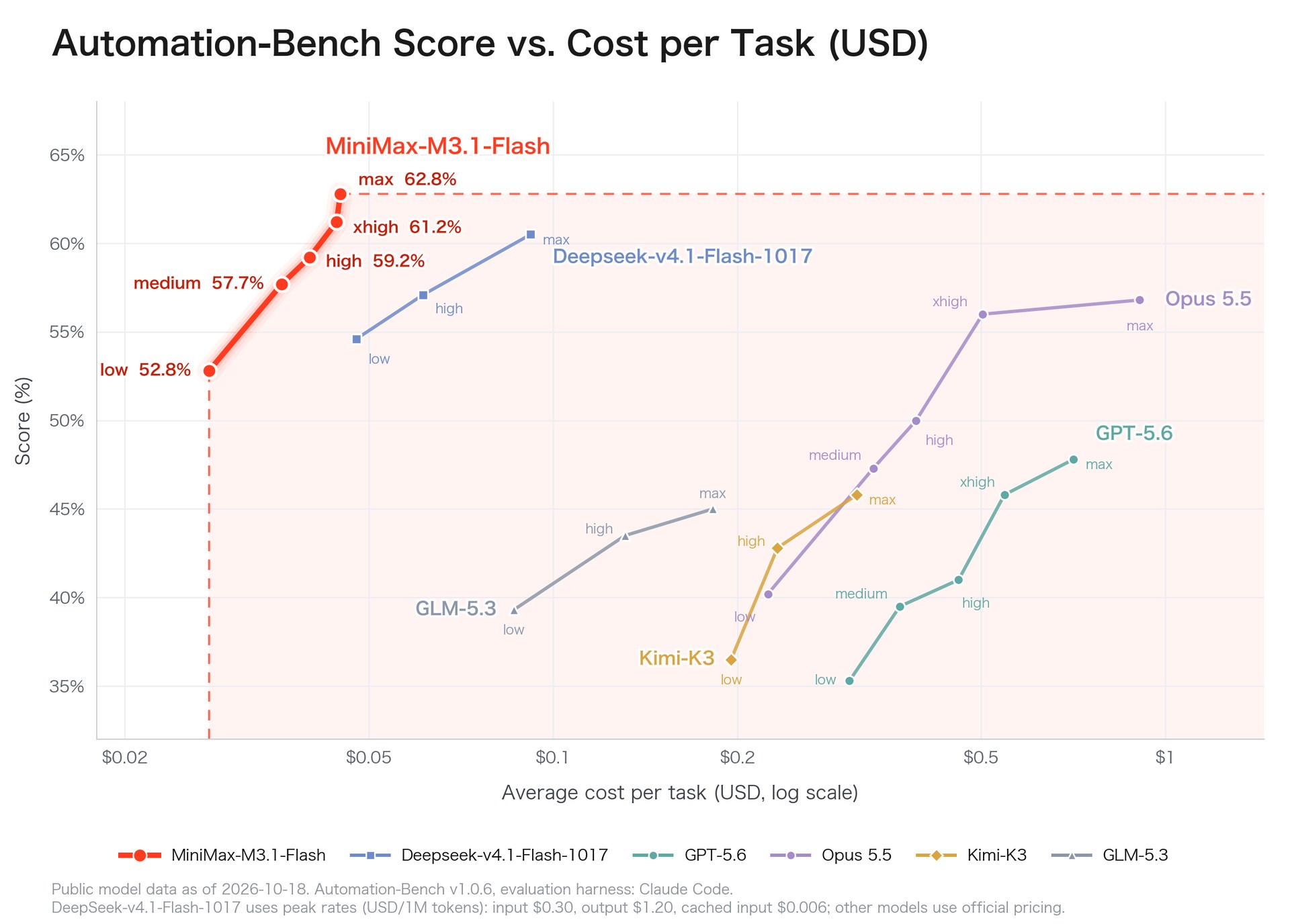
MiniMax released M3.1 Flash on October 19, describing improvements in agent tasks, coding, computer use, and inference speed. The company says online inference is nearly three times faster and overall usage cost is 70 percent lower than its predecessor. Its launch price is $0.15 per million input tokens, $0.60 per million output tokens, and $0.015 per million cached input tokens.
These prices make a narrow calculation straightforward. At the announced rates, one million uncached input tokens and one hundred thousand output tokens cost $0.21 in model usage. That example excludes tools, hosting, retries, and any other services. It is an illustration of the pricing units, not a forecast for a production workload.
An agent task contains many requests
A user asks for one result, but an agent may make a sequence of model calls before producing it. It can reread instructions, inspect files, request tools, and revise its plan. The cost of the finished task depends on the whole sequence.
A comparison should therefore record the total spend for successful completion and the proportion of attempts that fail. A low-cost attempt that regularly requires a second run may be less attractive than it first appears. Human repair time is relevant too, particularly when an output must be checked carefully before it can be used.
Test the exact work you would move
Choose a small group of repeatable tasks from the application: preparing a draft report, reconciling a set of records, or making a bounded software change. Keep the tools and instructions consistent with the existing system. Judge the final artifact against a defined outcome, rather than relying on the model’s statement that the task is complete.
Also examine the failure path. Can the agent explain missing information? Does it stop after a tool error or repeatedly spend tokens on the same unsuccessful action? These behaviors can materially change economics even if the underlying token rate is low.
The announced cached-input price creates a substantial difference between repeated and fresh context. Actual savings depend on whether the provider recognizes the repeated material under its caching rules. Measure cache behavior in the intended request pattern instead of assuming that every repeated paragraph receives the lower rate.
The MiniMax release strengthens the case for measuring agent systems in cost per useful outcome. Token prices are a necessary input to that calculation, but successful completion, elapsed time, and correction effort determine whether a lower-priced model actually makes the product cheaper to operate.
Have a correction or a useful perspective?
Get in touch with the publication.

