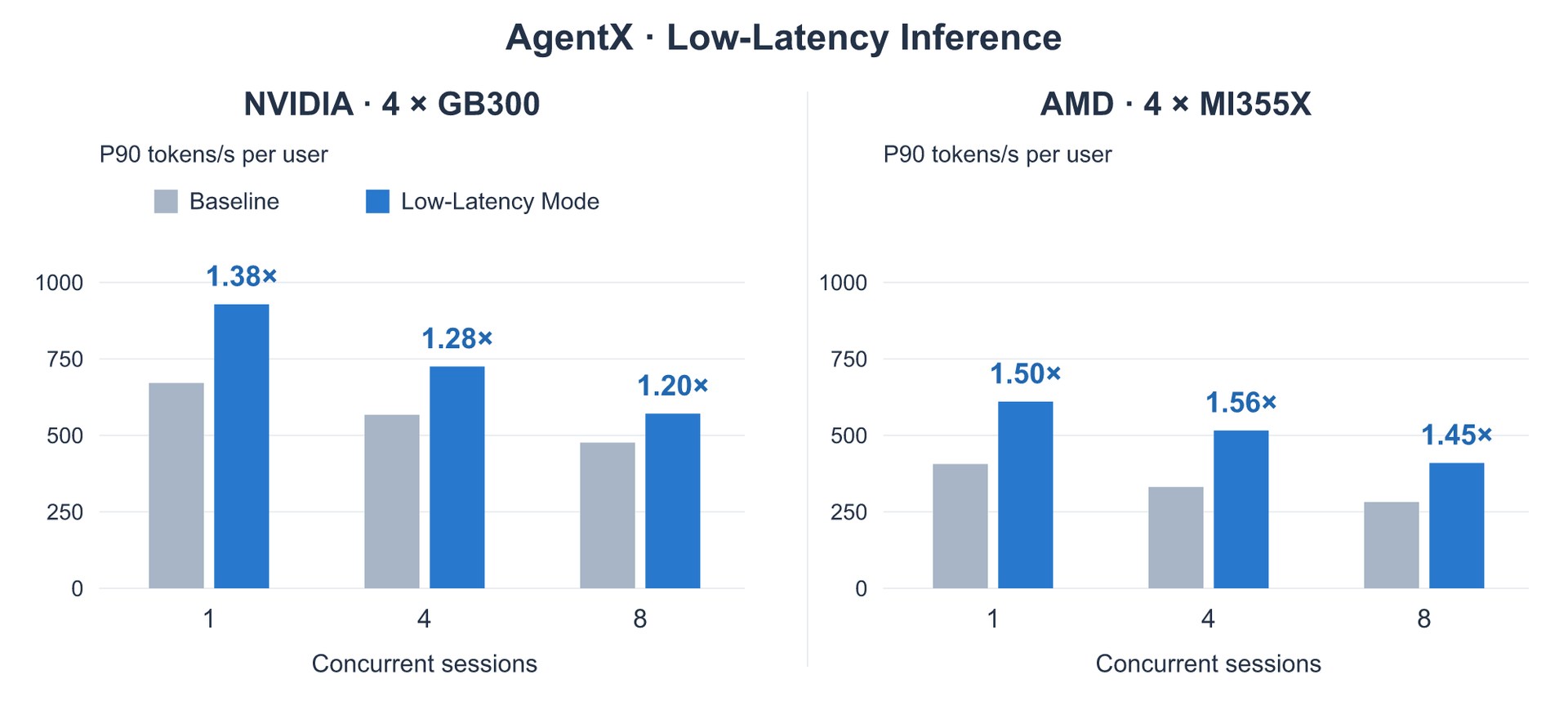
SGLang introduced Low-Latency Mode on October 18, using a plugin framework to bring specialized kernels into its inference runtime. The project reports improvements on both NVIDIA and AMD hardware. In its AgentX trace replay, P90 per-user token-generation speed rose from 671.2 to 928.4 tokens per second on four GB300 GPUs at one concurrent session.
| Configuration | Baseline | Low-Latency Mode |
|---|---|---|
| 4 NVIDIA GB300 GPUs, 1 session | 671.2 tokens/s | 928.4 tokens/s |
| 4 AMD MI355X GPUs, 4 sessions | 331.6 tokens/s | 516.0 tokens/s |
Each result compares the mode with a SGLang baseline on the same hardware. The different concurrency settings mean these figures are not a direct ranking of the GPU platforms.
Agents experience a chain of delays
An interactive agent often alternates between model generation and external actions. It reads a tool result, decides what to do next, and waits for another operation. Even when the total amount of generated text is modest, repeated delays can make the task feel slow.
This creates a different objective from an offline batch job processing a large queue. A batch operator may prioritize total completed work per hour. An interactive product may care more about the time one user waits for each meaningful step. The right serving configuration depends on which experience the application is trying to improve.
Specialization needs a clear boundary
Optimized kernels can exploit a particular model architecture and hardware configuration. That is why a benchmark result should travel with its setup. A speedup for a supported model under a small batch does not establish the same gain for every checkpoint or a heavily loaded server.
For a deployment trial, replay representative request sequences rather than only isolated prompts. Include long context, tool-result bursts, and the expected number of simultaneous sessions. Compare the complete task time as well as token speed. If external tools dominate the run, a substantial inference improvement may produce a smaller user-visible gain.
Keep maintainability in the comparison
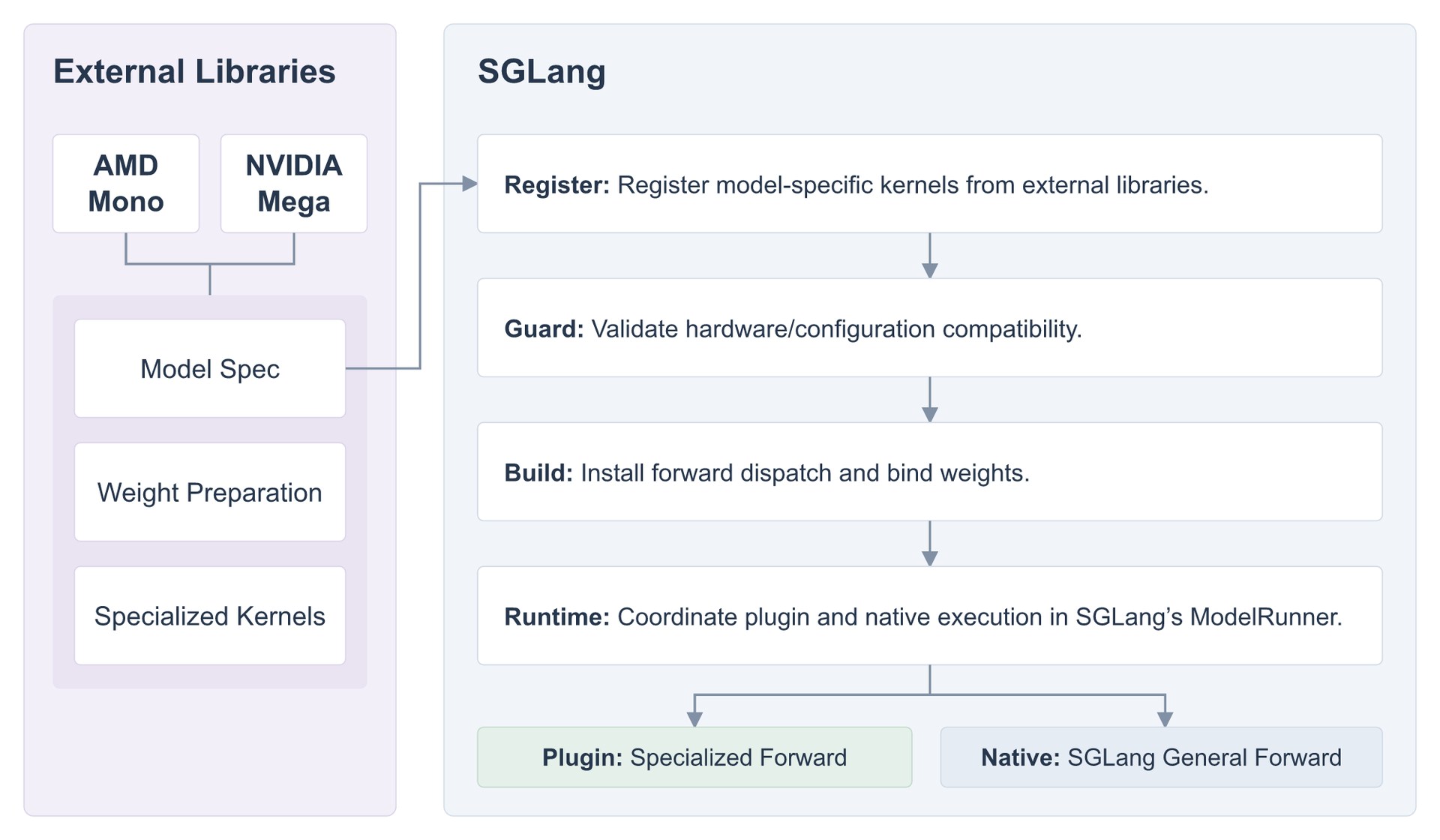
A plugin approach can help contain model-specific optimization, but operators still need to test upgrades and fallbacks. Record which plugin and runtime versions were used together. Confirm that the application behaves correctly if the optimized path is unavailable and the system returns to its ordinary implementation.
Monitor the slower end of the request distribution, not just averages. An assistant that is usually fast but occasionally stalls can be difficult to use in a time-sensitive workflow.
SGLang’s release makes low-concurrency serving a more explicit engineering target. The useful question is whether its specialized path shortens the actual chain of decisions and tool calls that a user experiences, within a configuration the team can maintain.
Have a correction or a useful perspective?
Get in touch with the publication.