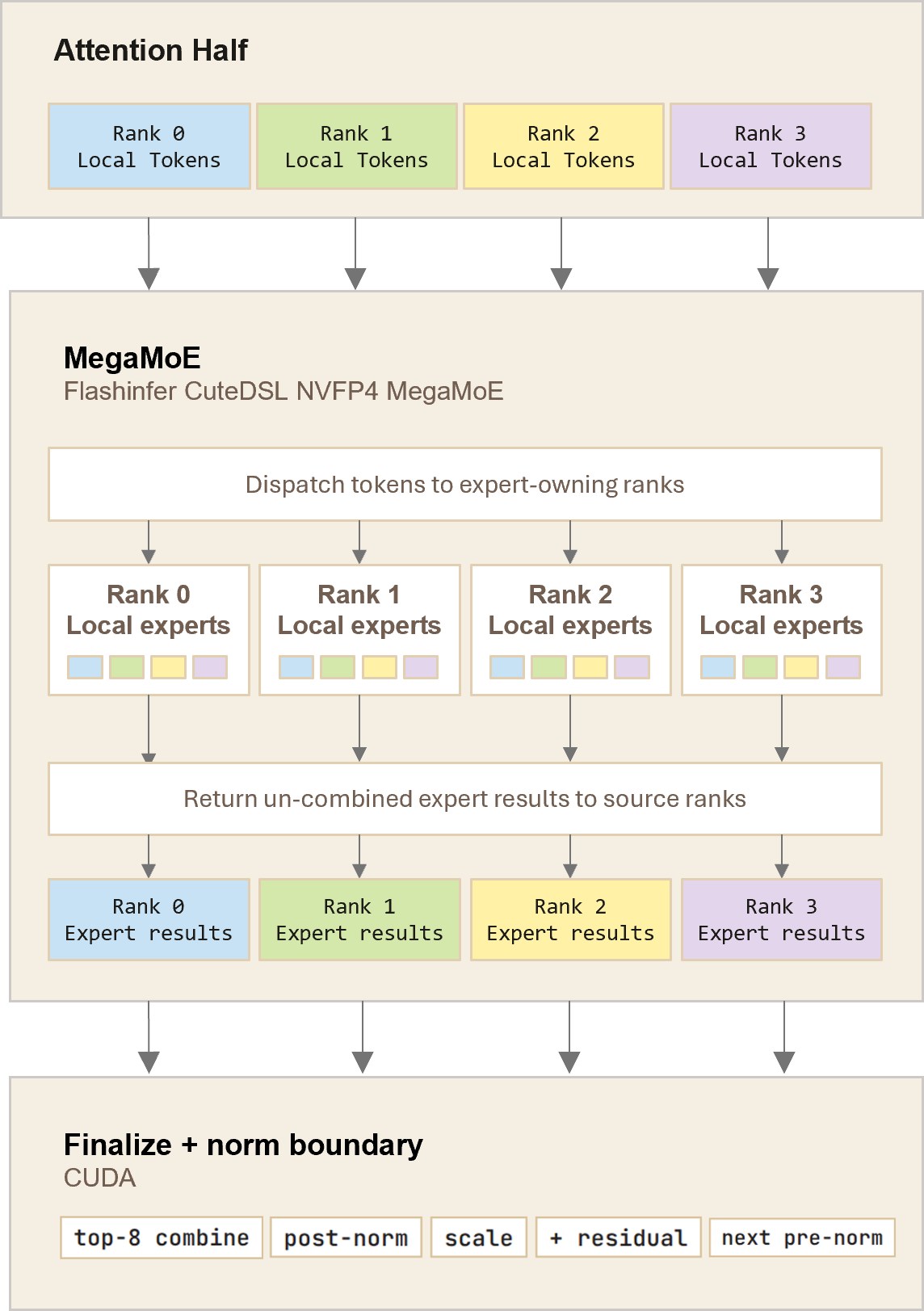
vLLM announced day-zero support for Reflection’s Beam on October 16. The serving team’s account describes a mixture-of-experts model with 501 billion total parameters and 23 billion active per token. It includes support for reasoning, tool calling, structured outputs, and several forms of parallel execution, with optimizations for NVIDIA Blackwell hardware.
The announcement also reports performance gains from model-specific optimization and speculative decoding. Those measurements depend on the stated hardware and request conditions. The broader point is that a model becomes operational through a collection of surrounding components, not simply because its weights or endpoint are available.
A tool call has to survive the interface
An agent application depends on distinguishing ordinary text from a tool request and extracting the request’s arguments correctly. A model may understand a task while a mismatched parser turns its output into an invalid call. Structured output creates a similar dependency between the model, the serving engine, and the application schema.
A deployment trial should therefore include the exact interfaces the product uses. Test missing arguments, long strings, empty results, and tool errors. Inspect whether the application can tell a valid final answer from an incomplete or interrupted response. These cases often reveal integration problems that a general question-answering demo will never exercise.
One fast request is one operating point
Speculative decoding can improve response speed by proposing tokens and checking them with the main model. Its benefit is a property of the full system and workload. A result for one request should not be assumed to hold when many users arrive together or when prompts become much longer.
Compare the serving configuration across a small range of concurrency levels. Record time to the first useful output, total completion time, and the slowest meaningful portion of the request distribution. A configuration that gives one user a very fast response may allocate capacity differently from one designed to serve a busy queue.
Keep the existing serving path available during an initial comparison. Route a limited class of tasks to the new model and retain enough information to reproduce a failure without exposing unnecessary user data. Model, parser, and runtime versions should move together as a known configuration.
Beam’s coordinated serving support reduces a common gap between a model announcement and a usable deployment. It also makes the evaluation more concrete. Buyers can assess the complete path from request to validated output, including the software that turns the model’s response into an action their application can safely interpret.
Have a correction or a useful perspective?
Get in touch with the publication.

