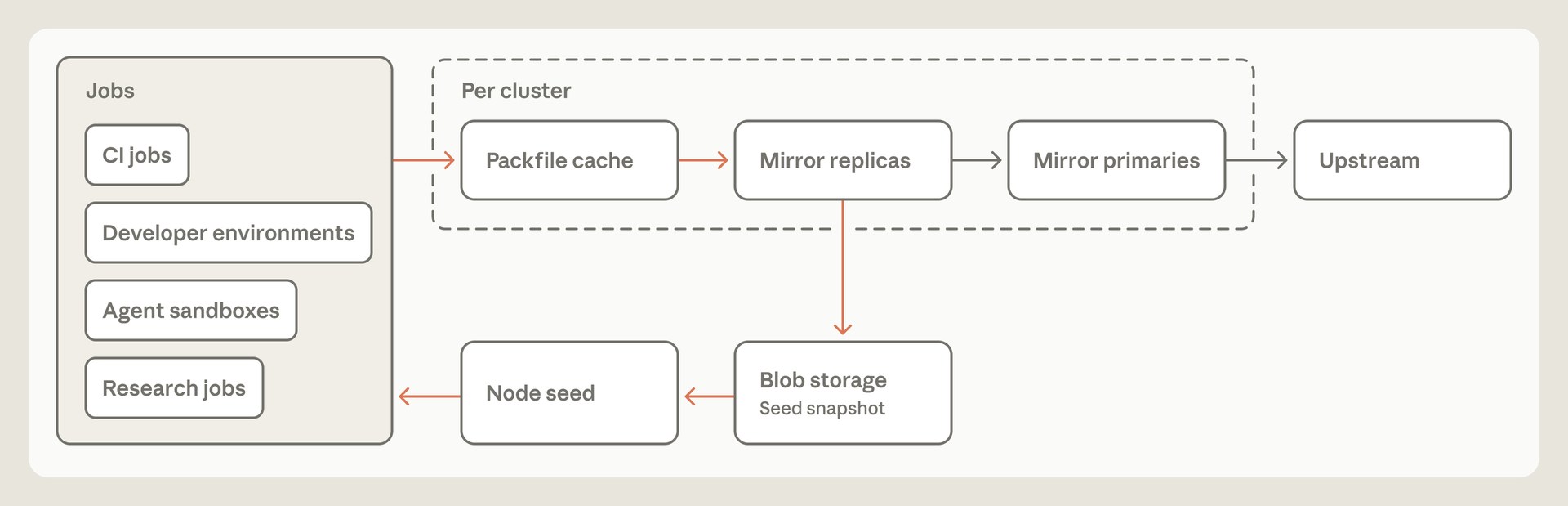
Anthropic’s October 13 engineering account describes building Scion, an internal version-control system, and migrating its monorepo from Git in five months. The company says daily merged changes grew from roughly 2,500 in May to more than 30,000 in September. It also reports unusually heavy checkout traffic from continuous integration, agent sandboxes, and research jobs.
Scion is designed around clients that are normally online and a server that handles many repository operations. Anthropic explicitly describes its workload as unusual. The case is therefore more useful as evidence of where pressure can accumulate than as a general recommendation for teams to replace Git.
Code generation can move the queue
If producing a change becomes faster, other parts of the development process receive more work. Reviewers see more proposals, build systems compile more revisions, and test environments must be created more often. A team can increase apparent coding output while delivering little additional value if those downstream stages become congested.
Measure the time a change spends waiting at each stage. A slow checkout suggests a different remedy from a long review queue or repeated integration conflicts. Looking only at how quickly an agent writes its patch can hide the actual constraint on delivery.
Short-lived clients change the economics
A human developer may reuse one working copy for weeks. An automated job may need a fresh environment for a few minutes. When the latter becomes common, repeatedly transferring repository data can consume significant time and capacity. Caching and narrower checkouts may help, but they introduce their own consistency and maintenance questions.
Teams should first determine which jobs genuinely require repository history and which only need a specific revision. Separating those requirements can reduce unnecessary work without changing the version-control system itself. The same review can identify jobs that fetch an entire repository merely to answer a small metadata question.
Centralization creates obligations
Moving more functionality into a central service can simplify clients, but it also makes service availability and recovery more important. A source-control outage can become a development outage. Migration plans must cover identity, audit history, backup, and a way to explain the state of a change when a request fails midway.
There is also a human interface to preserve. Developers need to understand which revision they are editing, which changes have been reviewed, and what will be merged. Faster infrastructure is not helpful if the state becomes harder to reason about.
Scion’s wider significance is that AI-assisted development is a systems problem. Teams should follow the queues created by increased output and fix the measured constraint. For many organizations that will mean improving existing workflows well before building a new repository service.
Have a correction or a useful perspective?
Get in touch with the publication.