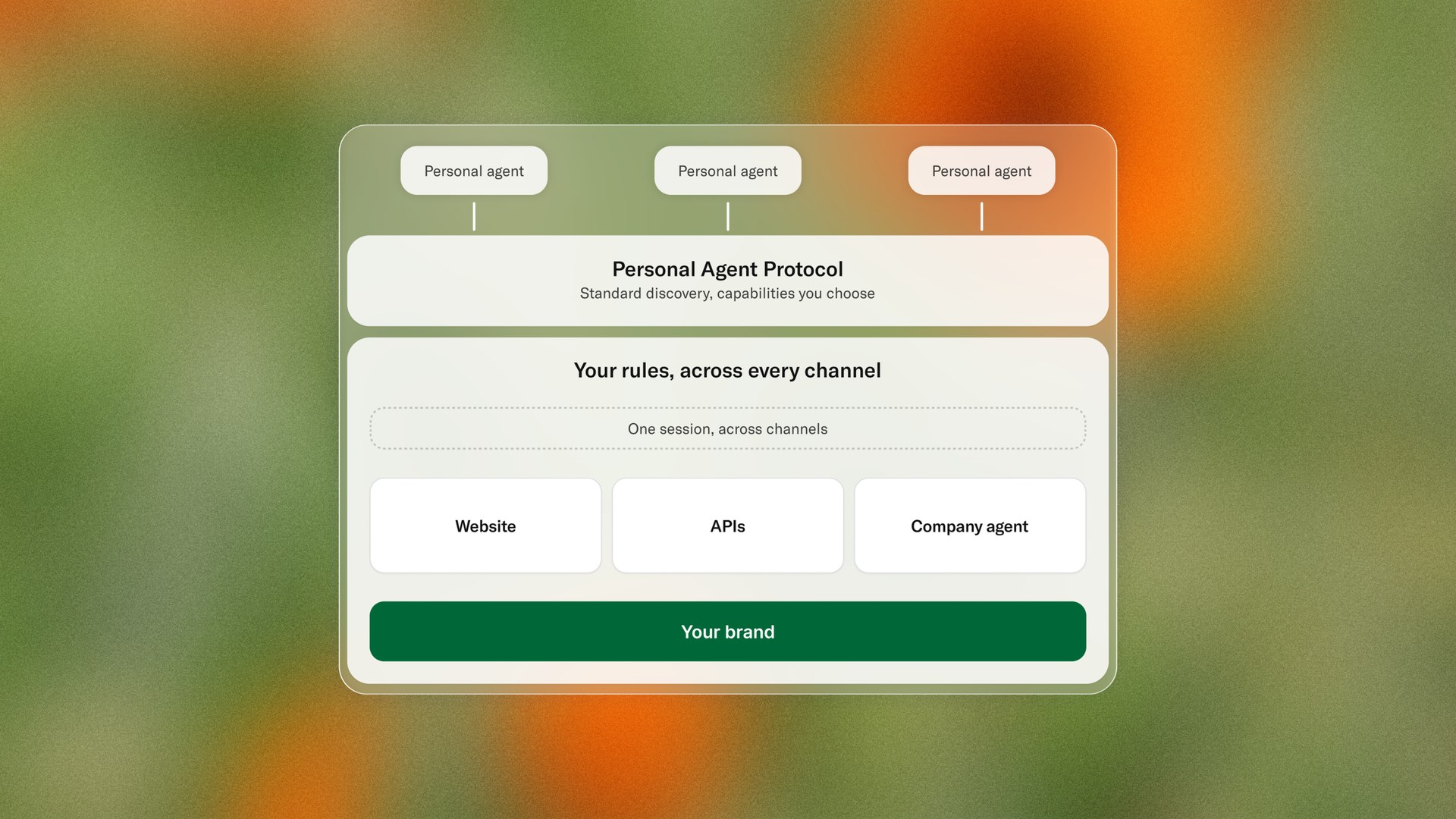
Sierra published a draft of Personal Agent Protocol, called Poppy, on October 9 and announced 35 additional design partners. The proposal covers discovery, sessions, customer sign-in, and continuity across a company’s website, APIs, or conversational agent. It builds on existing technologies including OAuth, HTTPS, OpenAPI, and MCP.
The problem is easy to recognize. A personal assistant may understand what its user wants, while a retailer or service provider has no standard way to recognize the assistant or the limits of its authority. The agent can end up navigating pages built for people, with identity and consent handled inconsistently between steps.
Identity is only the first handoff
A standard introduction would help a business distinguish a customer-authorized agent from an unidentified automated visitor. But knowing who an agent represents is not the same as knowing which action it may take. Changing a delivery preference and canceling an order can require different decisions even within one customer session.
A useful implementation would make those boundaries visible at the moment they matter. A hypothetical assistant could inspect appointment availability without permission to book, then ask the customer to confirm a time before submitting the change. The company must still enforce that distinction at its service boundary. A conversational promise alone should not decide what the account can do.
Continuity can reduce repeated explanations
One promising aspect of the draft is keeping a task connected as it moves between channels. A customer should not have to repeat the entire request because the assistant switches from browsing a policy page to calling an account API. The business likewise benefits from knowing which earlier conversation led to the final action.
That continuity needs careful state handling. If a request fails midway, the next attempt should reveal whether the action was completed, rejected, or never submitted. Otherwise, an agent trying to recover may create duplicate requests. A shared session is useful only when its status remains understandable to both sides.
A draft is the beginning of interoperability
The design-partner list shows interest, but participation does not mean every company has deployed compatible support. The important next evidence is working implementations that handle ordinary failures: expired authorization, withdrawn consent, unavailable services, and a person taking over the task.
For businesses evaluating Poppy, a modest initial workflow is more informative than a broad integration announcement. Choose a common task with a clear end state and limited consequences, then test it with more than one agent. The protocol’s practical value will come from reducing repeated integration work while leaving customers and companies able to understand and control the transaction.
Have a correction or a useful perspective?
Get in touch with the publication.