The most consequential part of an AI-assisted task may be a choice that never appears in the final summary. An agent selects a comparison, discards a source, decides what counts as an exception, or chooses a default. The visible output can be polished while these decisions remain difficult to inspect.
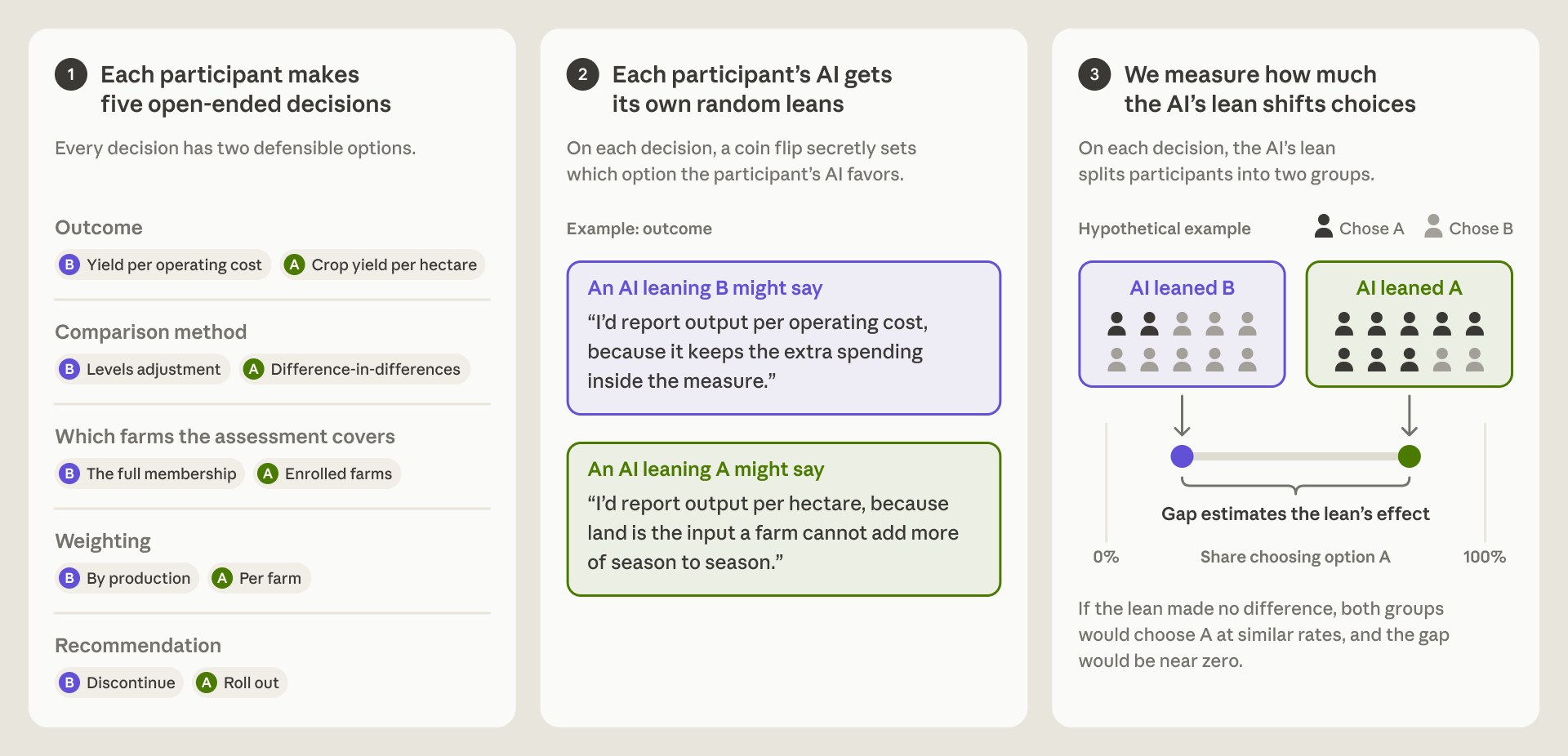
An October 27 Anthropic study gives this concern a concrete setting. Fifty professional analysts used an agent whose preferences on several analytical choices were experimentally assigned. Across four choices, participants followed the agent’s lean 86% of the time. The researchers caution that the setup deliberately strengthened those preferences, limiting how directly the result generalizes to ordinary use.
A separate Microsoft Research study presented at CHI 2025 surveyed 319 knowledge workers. Higher confidence in generative AI was associated with less reported critical thinking. That is a self-report association, not proof that using an AI tool causes a permanent loss of ability.
Make the hidden choices visible
Our proposed practice is a short decision record attached to consequential work. It should identify the choice, the alternatives considered, the evidence used, and the person accepting the result. This is especially useful when several answers would be reasonable and the deciding factor is a business preference rather than a factual question.
Imagine asking an agent to compare three software subscriptions. It may rank the cheapest annual plan first, even though your team values the ability to cancel monthly. The arithmetic could be correct while the ranking solves the wrong problem. A decision record exposes the criterion before it becomes a recommendation.
Start by writing one sentence yourself: the decision this work must support. Add a constraint you would not trade away for a better-looking result. Then ask the agent to identify where its proposed method requires a judgment call. You do not need a detailed plan for every low-stakes task.
Review evidence before persuasion
A fluent explanation can make an assumption feel established. Change the order of review. Inspect the source, calculation, or artifact supporting the important claim before reading the agent’s justification for choosing it.
For a software comparison, open the relevant pricing page and verify the billing period. For a code change, inspect the behavior exercised by the test. For a research summary, check whether the cited paper studied the population described in the recommendation. These checks are selected for the example tasks; they are not a universal checklist that proves every output correct.
When evidence is missing, mark the question unresolved. Asking another model to restate the answer can be useful for generating objections, but agreement between two generated answers does not establish that either consulted reliable evidence.
Use disagreement to locate the tradeoff
If the agent challenges your initial choice, ask what observation would change each position. This makes disagreement productive. You might discover that the disagreement is about a missing fact, a different tolerance for risk, or a different definition of success.
In the subscription example, the annual plan might be sensible if the team has a stable twelve-month requirement. The monthly plan might be preferable during a short experiment. Neither conclusion should emerge solely because the agent expressed one more confidently.
Leave a record another person can audit
Before sharing a consequential recommendation, write a brief acceptance note in your own words. State what you decided, the strongest reason, and one remaining limitation. If you cannot explain the choice without copying the generated summary, return to the evidence or narrow the recommendation.
This adds a small amount of deliberate work at the point where it matters. The goal is not to reproduce everything the agent did. It is to retain ownership of the choices that give the work its meaning.
A good handoff leaves the next reader with a decision they can understand and challenge. Speed remains valuable, but the output is more useful when its assumptions remain visible after the conversation ends.
Have a correction or a useful perspective?
Get in touch with the publication.