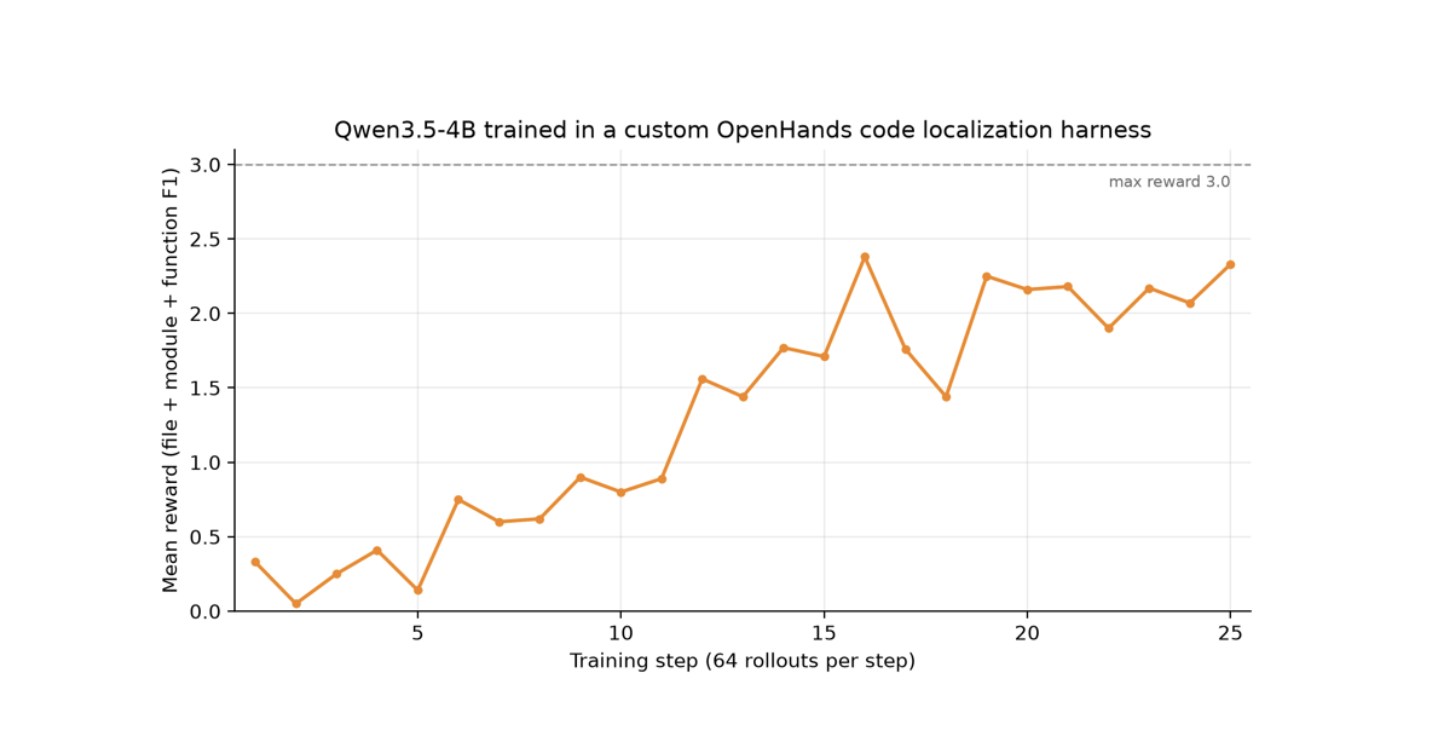
A coding agent is more than a model. Its instructions, tools, execution limits, and repository environment influence what it can accomplish. On November 3, OpenHands and Snowflake described a workflow for post-training open-weight models inside an existing OpenHands agent configuration, with Harbor tasks and managed training infrastructure. Their announcement and experiment argue that teams can reuse the agent harness instead of rebuilding it inside a separate reinforcement-learning framework.
The authors report a code-localization experiment, in which an agent identifies the files and functions relevant to a software issue. That is evidence for a particular workflow, not proof that every organization should train its own model. The more useful question is whether your agent’s recurring failures are stable enough to become a training target.
Start with the failure, not the training run
Imagine an internal agent that finds the correct implementation but repeatedly submits its answer in the wrong format. There are several possible explanations. The output tool might be confusing, the instruction might conflict with an example, or the model might struggle to follow that convention. Training is only one intervention. Fixing an ambiguous interface could be cheaper and easier to maintain.
Keep a small failure ledger before allocating compute. Record the task, the observed outcome, the desired outcome, and the earliest point where the run went wrong. Separate tool failures from model decisions. A timeout, missing dependency, and incorrect plan should not all become a single label called “agent failure.” They require different remedies.
The harness becomes part of the model specification
Our interpretation is that this approach changes what a team must version. A trained checkpoint without its matching tool schemas, prompt, and execution policy is an incomplete release. If a developer renames a tool argument after training, the model can face an interface different from the one that shaped its behavior.
Create a release record that binds the checkpoint to a specific harness revision. Include task definitions, environment images, reward logic, and the evaluation results used for acceptance. This record makes an apparent regression easier to investigate: did the model change, did the environment change, or did the definition of success change?
A reward can reward the wrong thing
A task score is an operational policy expressed as a number. If the grader only checks that an output file exists, an empty file might pass. If it checks an exact phrase, a correct but differently worded explanation might fail. These examples are hypothetical, but they show why verifier design deserves as much attention as the training recipe.
Before training, run the grader against deliberately bad answers and plausible alternative solutions. Confirm that it rejects superficial compliance and accepts legitimate approaches. For code changes, combine outcome tests with constraints such as preserving unrelated behavior. Keep a separate evaluation set that is never used to choose individual training examples.
Measure the whole economic unit
The useful unit is a completed, acceptable task. Training time, serving cost, retries, and human review all contribute to that unit. A smaller specialized model might generate cheaper attempts yet require more supervision. A more expensive attempt might be worthwhile if it reliably produces work that a reviewer can accept quickly.
For a pilot, compare three baselines on the same held-out tasks: the current agent, the current agent with obvious harness fixes, and the post-trained candidate. Track completion quality, elapsed time, tool calls, and review effort. Predefine a stopping rule so that a rising training reward does not keep an unproductive experiment running indefinitely.
Who should explore this first?
This is most interesting for teams with a repeated, well-defined workflow and a way to verify outcomes. Repository triage, structured extraction, or bounded maintenance tasks can offer clearer feedback than open-ended strategy work. Teams still changing their task definition every week should stabilize that definition first.
The announcement makes harness-specific training more approachable. It does not remove the need to decide what good work means. Treat the first training run as a controlled experiment, preserve its artifacts, and promote a checkpoint only when its held-out results improve the workflow you actually operate.
Have a correction or a useful perspective?
Get in touch with the publication.