
How AI Changed the Way Content Is Created
Why content creation matters in online business today
Content creation is a core part of almost every online business. Websites, blogs, social media pages, emails, and videos all rely on content to communicate ideas and attract people. For beginners, content is often the first way to share knowledge, build trust, and explain what they offer online.
In the past, creating content required strong writing skills, a lot of time, and sometimes a team. Today, content still matters just as much, but the way it is created has changed. Technology has made content creation more accessible, even for people with limited experience
This topic connects closely with Technology and Online Business – The Complete Beginner’s Guide, which explains how digital tools support modern online businesses and remote work.
The rise of AI tools in everyday digital work
AI tools have become part of daily digital work without many people noticing it. Tools that help with writing ideas, organizing outlines, correcting grammar, or suggesting improvements are now common. These tools do not create businesses on their own, but they support the people who do the work.
For content creation, AI tools act like assistants. They help speed up simple tasks and reduce repetitive work. Instead of starting from a blank page, beginners can use AI to get suggestions and structure.
Beginners can explore this idea further in How Beginners Can Use AI Tools Responsibly for Online Work, which explains how to use AI tools wisely without relying on them too heavily.
How this article helps beginners understand AI simply
Many beginners feel confused when they hear about AI tools. The topic can sound technical or overwhelming. The goal of this article is to explain AI tools for content creation in simple, clear language.
This article also connects naturally to Technology and Online Business – The Complete Beginner’s Guide, which explains how technology supports online business overall. Here, the focus is on how AI tools support content creation as one part of modern online work.
By the end of this article, beginners should understand that AI tools are helpers—not shortcuts—and that real progress still comes from learning, effort, and consistency.
Content Creation Before AI Tools Existed

Before AI tools became available, content creation depended almost entirely on human effort. Writers, bloggers, and online business owners had to rely on their own skills, time, and experience to produce every piece of content. While this approach worked, it created many challenges, especially for beginners.
How people created content manually in the past
In the past, content was created from scratch. Writers had to research topics on their own, organize ideas manually, and write full drafts without any digital assistance. Editing was also done by hand, often requiring multiple revisions.
For blog posts, emails, or website pages, this process could take many hours or even days. Beginners had to learn writing, structure, grammar, and clarity all at once. There were very few tools to guide them or speed up the process.
Time, effort, and skill barriers beginners faced
One of the biggest challenges for beginners was time. Creating content manually required long periods of focus and energy. For people working alone or starting an online business part-time, this often led to slow progress.
Skill was another major barrier. Beginners needed writing ability, research skills, and basic marketing knowledge at the same time. Without experience, many people felt overwhelmed and unsure if their content was good enough to publish.
Because of these barriers, many beginners stopped early, not because their ideas were bad, but because the process felt too difficult.
Why consistency and quality were harder to maintain
Maintaining consistent content was also harder before AI tools. Writing regularly required strong discipline and a steady flow of ideas. When motivation dropped or time was limited, content schedules were easily broken.
Quality was another issue. Without support tools, mistakes in grammar, structure, or clarity were common. Improving content quality required feedback from others or repeated practice over long periods.
These challenges explain why content creation used to feel slow and demanding. Understanding this background makes it easier to see why AI tools later became helpful support systems for modern content creators.
What Are AI Tools for Content Creation? (Simple Explanation)
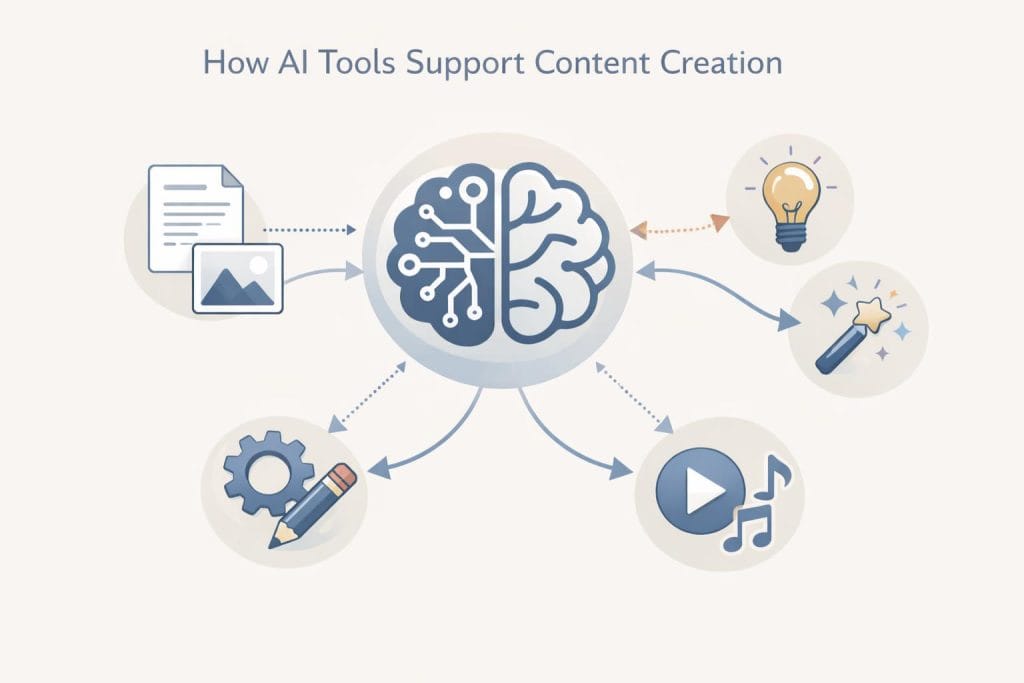
AI tools for content creation are digital tools that help people create, improve, and organize content faster. They do not replace the creator. Instead, they act as support tools that make the work easier, especially for beginners who are still learning.
These tools are widely used in blogging, social media, email writing, and website content.
A practical overview can be found in Best AI Tools for Beginners (No Technical Experience Required), which introduces beginner-friendly tools that are easy to start using.
What AI tools do in plain, non-technical terms
In simple terms, AI tools help you think, write, and organize better. You give them instructions, and they respond with suggestions or drafts based on that input.
For example, an AI tool can help you turn a simple idea into a paragraph. It can also help rephrase sentences to sound clearer. Think of AI as a smart assistant that helps you get started and improve your work, not as something that works alone.
You are always the one in control. The tool only responds to what you ask.
Tasks AI can support (writing, ideas, editing, structure)
AI tools can support many common content tasks:
Writing support: Helping draft blog posts, emails, or short content pieces
Idea generation: Suggesting topics, titles, or angles when you feel stuck
Editing help: Improving grammar, clarity, and sentence flow
Content structure: Helping organize headings, sections, and outlines
These features are especially useful for beginners who may struggle with where to start or how to organize their content clearly.
What AI tools cannot do on their own
AI tools have limits. They cannot understand your personal goals, audience emotions, or real-world experience on their own. They also cannot replace creativity, strategy, or decision-making.
AI does not know your brand voice unless you guide it. It cannot verify facts perfectly, and it cannot guarantee quality without human review.
This is why AI works best when combined with human thinking. The best content still comes from people who guide the tools with clear ideas and judgment.
Types of AI Tools Used in Content Creation
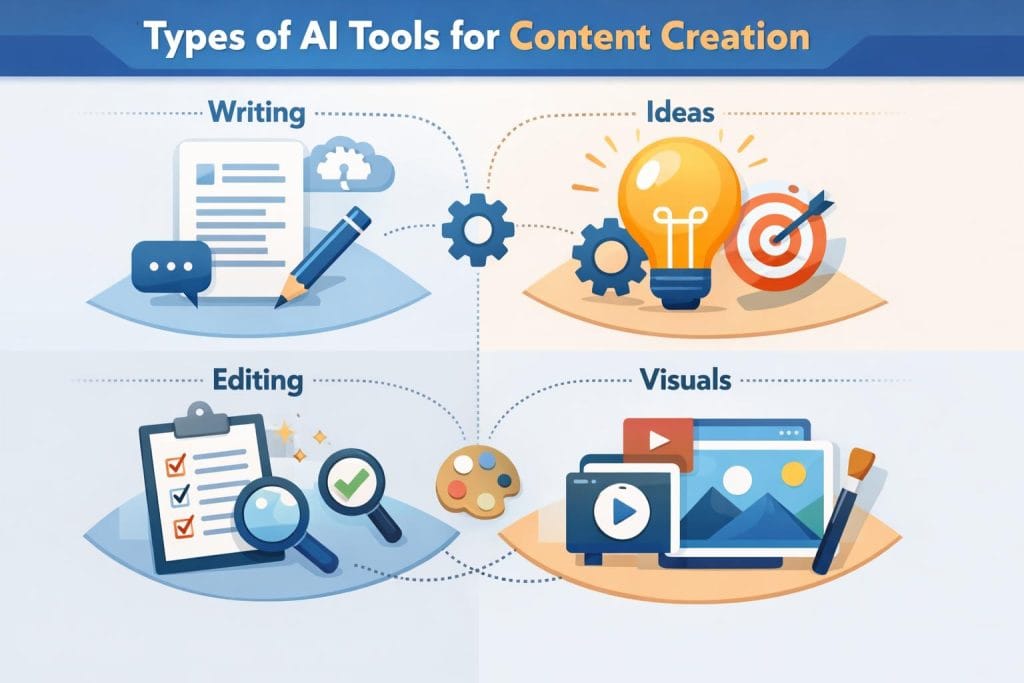
AI tools used in content creation come in different types. Each type supports a specific part of the content process. Beginners do not need to use all of them at once. Understanding the main categories helps you choose tools that match your current needs.
These tools are designed to support thinking, writing, improving, and presenting content more efficiently.
AI writing and text assistance tools
AI writing tools help users create written content faster. They support tasks such as drafting blog posts, writing short articles, creating social media captions, and preparing basic website text.
For beginners, these tools are useful because they reduce the fear of a blank page. You can start with a simple idea, and the tool helps turn it into readable text. The final result still needs human review, but the starting point becomes much easier.
These tools are commonly used by bloggers, students, freelancers, and small website owners.
AI tools for idea generation and topic planning
Idea generation tools help when you do not know what to write about. They suggest topics, content angles, outlines, and possible questions related to a subject.
For beginners, this is especially helpful during the early stages of content creation. Instead of guessing what to write, you can explore structured ideas and choose what fits your audience best.
These tools support planning, not decision-making. The creator still chooses which ideas are relevant and useful.
This process is part of the larger system explained in How Technology Supports Legit Online Income Opportunities, where digital tools help people build real online work.
AI tools for editing, clarity, and grammar support
Editing-focused AI tools help improve clarity, grammar, and sentence flow. They do not replace learning how to write well, but they help reduce simple mistakes.
Beginners benefit from these tools because they make content easier to read and understand. Clear content builds trust with readers and improves overall quality without requiring advanced language skills.
These tools are commonly used during the final review stage of content creation.
AI tools for visual and multimedia content support
Some AI tools assist with visuals and multimedia. They can help generate images, suggest design layouts, or support basic video and audio preparation.
For beginners who do not have design experience, these tools make visual content more accessible. They help create simple graphics or visual ideas that match written content.
Visual tools work best when guided by clear instructions. Human creativity and judgment are still needed to ensure the visuals fit the message.
How AI Tools Support Different Content Formats

Content today appears in many formats. Online businesses no longer rely on text alone. AI tools help creators handle different content types more easily, even without advanced skills.
For beginners, this support reduces workload and makes it possible to stay consistent across platforms.
Blog articles and website content
AI tools are widely used to support blog writing and website content. They help with drafting articles, structuring headings, improving clarity, and expanding ideas.
For beginners, this makes long-form writing less intimidating. Instead of starting from scratch, creators can work from a draft and refine it using their own understanding.
AI tools do not replace original thinking. They support the writing process and help maintain consistency across pages.
This content model is explained further in Content-Based Online Income Explained for Beginners, which shows how blogs and digital content can support online income.
Social media posts and captions
Creating short content regularly can be challenging. AI tools help generate social media captions, post ideas, and short descriptions for different platforms.
Beginners benefit because these tools save time and reduce creative pressure. You can adapt one idea into multiple short posts while keeping the message clear and simple.
This support is especially useful for maintaining an active online presence.
Video scripts and podcast outlines
AI tools can help structure video scripts and podcast outlines. They assist with introductions, talking points, and logical flow.
For beginners who feel unsure about speaking or recording, having a clear outline increases confidence. It helps content creators stay focused and organized without memorizing long scripts.
The human voice, tone, and personality remain essential. AI only supports preparation.
Emails and basic marketing content
Emails and basic marketing messages are another area where AI tools help. They support writing newsletters, simple promotional emails, and informational messages.
Beginners often struggle with wording and structure. AI tools provide a starting point that can be adjusted to sound natural and appropriate.
Clear communication builds trust, and AI helps reduce common mistakes without removing the human element.
How AI Tools Lowered Barriers for Beginners

Before AI tools became common, many people felt that content creation was only for experts. Writing, planning, and publishing content seemed difficult and time-consuming. AI tools changed this situation by making the process more accessible.
Today, beginners can start creating content with fewer obstacles. AI tools do not remove the need for effort, but they make the starting point much easier to reach.
This accessibility is discussed in Why Online Business Has Low Entry Barriers for Beginners, which explains how technology made online work easier to start.
Creating content with fewer skills
AI tools allow beginners to create content without advanced writing or technical skills. They help with structure, clarity, and basic organization.
Instead of learning everything at once, beginners can focus on ideas and understanding their topic. The tools support the technical side of content creation while the user learns step by step.
This lowers the entry barrier and makes content creation feel achievable rather than overwhelming.
Faster learning through experimentation
AI tools encourage learning by doing. Beginners can test ideas, rewrite drafts, and try different formats without fear of making mistakes.
This experimentation speeds up learning. Users see immediate results and understand what works and what does not. Over time, this builds confidence and practical experience.
Learning becomes a gradual process instead of a long preparation phase.
Reducing fear and confusion when starting online
Starting an online project often comes with uncertainty. Many beginners worry about doing things “the wrong way.” AI tools reduce this fear by offering guidance and structure.
When beginners have support during writing and planning, they feel less lost. This clarity helps them take action instead of delaying their start.
By reducing confusion, AI tools help beginners move forward with more confidence in online content creation.
Real-Life Beginner Examples Using AI Tools

To understand how AI tools work in real situations, it helps to look at simple beginner examples. These are not advanced businesses or large teams. They are everyday online projects started by people with limited experience.
These examples show how AI tools support content creation without replacing human effort.
A new blogger using AI for outlines and drafts
A beginner blogger often struggles with where to start. Choosing topics, organizing ideas, and writing the first draft can feel overwhelming.
AI tools help by creating clear outlines and rough drafts. The blogger still reviews, edits, and adds a personal voice. The tool only provides structure and direction.
This makes blogging feel more manageable and helps beginners publish content consistently while learning along the way.
A freelancer improving writing speed and clarity
Many freelancers know their subject well but spend too much time rewriting and correcting content. This slows down their work and reduces productivity.
AI tools assist by improving sentence clarity, fixing basic grammar, and suggesting smoother wording. The freelancer stays in control of the final result.
With this support, freelancers work faster, communicate more clearly, and focus more on delivering value to clients.
A small online project maintaining consistent content
Small online projects often stop because content creation becomes difficult to maintain. Lack of time and ideas can lead to long breaks.
AI tools help by supporting content planning and keeping ideas organized. They make it easier to prepare content in advance.
This consistency helps small projects stay active online without requiring a large team or advanced skills.
Benefits of Using AI Tools for Content Creation

AI tools have become helpful partners in content creation, especially for beginners and small online projects. They do not replace human thinking or creativity. Instead, they support the process and make content work easier to manage.
Below are the main benefits explained in simple terms.
Saving time without losing control
Creating content often takes more time than expected. Planning, drafting, editing, and organizing can slow down progress.
AI tools help reduce this time by assisting with outlines, first drafts, and basic improvements. However, the creator still decides what to keep, change, or remove.
This means time is saved without giving up control. The final content remains human-guided and aligned with personal goals.
Improving consistency and structure
One common challenge in content creation is staying consistent. Many beginners start strong but struggle to keep a regular publishing rhythm.
AI tools help by supporting structure and organization. They make it easier to follow clear formats and logical flow across articles, posts, or scripts.
With better structure, content feels more professional and easier for readers to follow, even when created by beginners.
Supporting creativity instead of replacing it
A common misunderstanding is that AI removes creativity. In reality, it often does the opposite.
AI tools handle repetitive or basic tasks, such as formatting ideas or correcting sentences. This frees up mental space for creative thinking.
Creators can focus more on ideas, storytelling, and personal insight, while AI supports the technical side of content creation.
Limitations and Challenges of AI Content Tools

While AI tools can be very helpful in content creation, they also come with clear limitations. Understanding these challenges helps beginners use AI in a smart and balanced way, instead of depending on it too much.
AI still needs human direction
AI tools do not work independently. They follow instructions and patterns, but they do not understand goals the way humans do.
Without clear guidance, AI can produce content that feels unclear, repetitive, or off-topic. This is why human input is always required. The user must decide the topic, tone, and final message.
AI supports the process, but humans lead it.
Risk of over-reliance on tools
One common challenge is relying too much on AI tools. When creators depend fully on tools, they may stop improving their own skills.
Over time, this can reduce critical thinking and creativity. Content may start to sound similar or lack personal insight.
Using AI as support, not as a replacement, helps avoid this problem and keeps learning active.
Why originality and judgment still matter
AI tools generate content based on existing data and patterns. They do not create original ideas in the human sense.
Human judgment is needed to check accuracy, add personal experience, and make content meaningful. Originality comes from perspective, not from tools.
This is why strong content always combines AI assistance with human thinking and decision-making.
Common Misconceptions About AI Content Tools
AI content tools are often misunderstood, especially by beginners. These misconceptions can create fear, confusion, or unrealistic expectations. Clarifying them helps users adopt AI in a practical and balanced way.
“AI writes everything for you”
One common belief is that AI tools can fully replace human writers. This is not true.
AI does not understand goals, audience intent, or context on its own. It responds to instructions and patterns. Without human guidance, the output can feel generic or unfocused.
In real use, AI helps draft ideas, organize structure, or improve clarity. The human still plans, edits, and decides what gets published.
“Using AI means low-quality content”
Some people think AI automatically produces poor or spam content. In reality, quality depends on how the tool is used.
When AI is guided with clear prompts and reviewed by a human, it can support high-quality writing. Poor results usually come from copying AI output without editing or understanding the topic.
Quality comes from judgment, not from avoiding tools.
“Beginners cannot use AI effectively”
Another misconception is that AI tools are only for experts. In fact, many AI tools are designed for beginners.
Simple interfaces and guided prompts make it easier for new users to start creating content. Beginners often benefit the most because AI reduces fear and lowers the learning curve.
With practice, beginners can quickly learn how to use AI as a helpful assistant rather than a replacement.
How Beginners Can Use AI Tools Responsibly
AI tools can be very helpful, but only when they are used in a thoughtful way. For beginners, responsible use means learning, improving, and staying in control of the content creation process.
Using AI as an assistant, not a shortcut
AI works best when it supports your thinking, not when it replaces it. Beginners should treat AI as a helper that saves time, not as a machine that does all the work.
For example, AI can help you create outlines, suggest ideas, or improve sentence flow. But deciding what to say, who the content is for, and why it matters should always come from you.
When AI is used as a shortcut, learning slows down. When it is used as an assistant, learning becomes faster and clearer.
Reviewing and improving AI-generated content
AI-generated content should never be published without review. Beginners should always read, edit, and improve what AI produces.
This step helps remove unclear sentences, fix mistakes, and add personal understanding. It also ensures the content sounds natural and fits the topic properly.
Reviewing AI output is not a weakness. It is an important skill that improves both content quality and confidence.
Learning skills alongside AI usage
AI tools should support skill development, not replace it. Beginners still need to learn basic writing, structure, and communication skills.
By comparing AI suggestions with their own ideas, beginners can understand why certain sentences work better than others. Over time, this builds real ability.
The goal is not to depend on AI forever, but to grow alongside it while gaining practical experience.
Frequently Asked Questions (FAQ)
H3: Are AI tools safe for beginners to use?
Yes, most AI tools are safe for beginners when used responsibly. Many popular AI tools are designed with simple interfaces and clear guidelines. Beginners should still read basic terms of use and avoid sharing sensitive personal information. When used for learning, writing support, and idea generation, AI tools are generally safe and helpful.
Can AI tools help beginners earn online?
AI tools can support beginners, but they do not create income on their own. They help save time, improve content quality, and reduce confusion when starting online work. Earning online still depends on skills, effort, and consistency. AI tools simply make the process easier and more organized.
Do AI tools replace writing skills?
No, AI tools do not replace writing skills. They assist with structure, clarity, and ideas, but human thinking and judgment are still required. Beginners who review and edit AI-generated content often improve their writing skills over time. AI works best as a learning partner, not a replacement for real ability.
Conclusion – AI as a Support Tool for Modern Content Creation

Key takeaways for beginners
AI tools have changed how content is created, especially for beginners. They make writing easier, faster, and more organized. They help with ideas, structure, and clarity. However, they do not remove the need for learning and effort. Beginners benefit most when they use AI as a guide, not as a shortcut.
Why AI works best with human effort
AI tools are powerful, but they still depend on human direction. They follow instructions, patterns, and examples. Quality content still requires human judgment, creativity, and responsibility. When beginners review, edit, and improve AI-assisted content, the final result becomes more original, useful, and trustworthy.
The broader transformation of digital work is explored in How Technology Changed the Way People Do Business Online, which explains how technology reshaped modern online business systems.




2 Comments on “AI Tools for Content Creation Explained in Simple Language”